ABOUT – THE ISOLATION ECONOMY
For four centuries, the Western world has built its institutions on an idea that was never intended to leave philosophy: the human being as an isolated point. That idea shaped modernity, digitalization, and the platform economy. AI is now revealing what that architecture has always concealed – and making it unsustainable.
From Philosophy to Business Model: A 400-Year Journey
When René Descartes formulated Cogito ergo sum in 1637, he was not trying to design the future economy. He was trying to solve an epistemological problem: how can we know anything with certainty? His solution was radical: doubt everything – the senses, the body, the world – until only one thing remains. The thinking self. The isolated subject.
It was a brilliant philosophical move. But it had consequences Descartes never imagined.
From 1637 onward, the Western world’s institutions – economy, law, education, technology – were built on the idea of the human being as an isolated point. The internet is the culmination of that architecture. AI is its collapse.
You change jobs. Your professional history no longer knows you. Your contributions exist — but not where you are now. You start from zero. Again. It feels normal. It is designed.
AXIOM
What began as a method for epistemological certainty became a mechanism for economic extraction.
Translated into economic notation:
V_individual = f(T)
The individual’s economic value is a function of the individual’s isolated behavior. Nothing else counts.
The digital economy’s aggregate value then becomes:
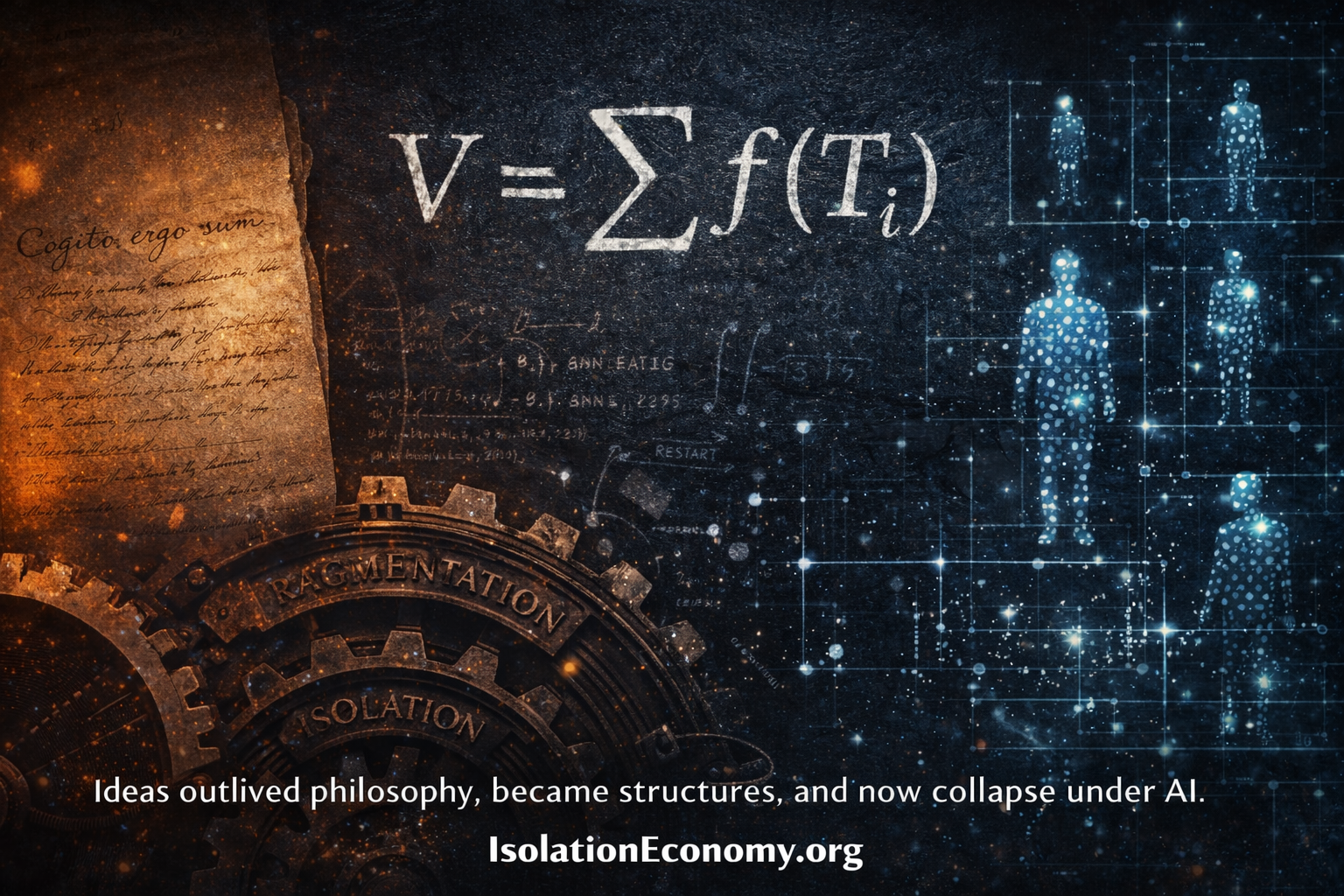
V = Σ f(Tᵢ)
The sum of all isolated individuals’ behaviors. This is Cogito Ergo Sum in algorithmic form.
When the human being is defined as a point of consciousness separated from relationships, from the body, from the world, a model is created that is perfect for measurement. An isolated individual can be analyzed as a variable. A solitary data point can be quantified as a signal. A subject without context can be controlled as a resource.
Descartes abstracted the human being. Digitalization commercialized the abstraction.
How Philosophy Became Structure
Ideas outlive their origins by dissolving into culture. Descartes’ isolated subject became so normalized that it ceased to be an idea and became reality. The Enlightenment turned it into an ideal. The individual’s freedom. The individual’s rights. The individual’s responsibility. All constructed around a human being who is fundamentally alone.
Industrialism operationalized it. A worker on an assembly line is a measurable unit. A consumer in a market is a data point in demand. Economic theory was built on the isolated actor – homo economicus – who makes rational decisions independent of relationships.
Capitalism perfected it. Value is created through exchange between separate individuals. Ownership is individual. Responsibility is individual. Success is individual.
Digitalization did not make isolation possible. It made it inevitable.
It was digitalization that transformed isolation from cultural norm to technical architecture, from philosophical position to economic infrastructure.
When the Architecture Became Invisible
Today’s digital systems are built on Cartesian logic without anyone consciously choosing it. It simply felt ”natural” that:
- Every user has a separate account
- Every platform is its own island
- Every interaction starts from zero
- History is local, not portable
- Relationships exist only within the system
- Identity must be proven again and again
These are not technical limitations. They are structural design based on a 400-year-old understanding of what a human being is.
And that design has an economic property: it is extremely profitable.
Problem Statement
Today’s digital economy is built on the assumption that isolated data points are reliable signals for identity, competence, and intention.
This assumption held as long as humans were the primary source of human signals.
When AI can produce synthetic identities, histories, and behavioral patterns at lower cost than humans, isolated data points lose their verification value.
The result is not a temporary security problem, but a structural collapse in how digital trust, value, and accountability are established.
The Mechanisms: How Isolation Becomes Value
Fragmentation is not a consequence of digital systems – it is their primary revenue engine.
The Three Laws of the Isolation Economy
Law 1: Fragmentation multiplies data value. A coherent identity generates one signal. Ten fragments generate a hundred.
Law 2: Isolation enables predictability. Relationships are noise. Isolated individuals are patterns.
Law 3: Restart is revenue. Platforms don’t profit when you’re done – they profit when you start over.
These laws operate through four interconnected mechanisms that together constitute the system’s operational logic:
1. Fragmentation Creates Data Multiplication
When your identity is divided across platforms, data points multiply. The same competence must be proven ten times. The same relationship established in ten separate systems. The same question asked a hundred times in different contexts. Every fragment is an interaction. Every interaction is a data point. Every data point is value that can be sold.
PRINCIPLE: If you had a coherent identity, you would generate one data stream. Fragmented, you generate a hundred.
2. Isolation Enables Profiling
An isolated individual is easier to understand than a relational node. When you search alone, your preferences are clearly visible. When you consume alone, your patterns are directly apparent. When you interact without context, every choice becomes a signal.
Relationships create noise. Context creates complexity. Isolation creates clarity. And clarity is predictability. And predictability is money.
3. Lack of Portability Generates Lock-in
When your history, your relationships, and your reputation are trapped in a system, you cannot leave without losing everything. Every switch is a reset. Every migration is a loss of context.
This creates enormous switching costs – not technical, but social and cognitive. You don’t stay because the system is good. You stay because the alternative is starting from zero.
4. Every Restart is a Revenue Opportunity
Platforms don’t profit from you being done. They profit from you starting over. Every new registration. Every new establishment. Every new proof of who you are.
This is not inefficiency – it is the business model.
In a world where continuity has no value, discontinuity becomes the primary revenue model.
Working Life
When an individual changes workplace, the digital continuity for competence, contributions, and relationships is broken.
Previous achievements become local artifacts rather than portable assets.
The system interprets this as absence of signal – not as absence of value.
Education
Competence developed in an educational context exists only there. When the student leaves the institution, the evidence of what they learned to do disappears – not what they learned about. The system can verify examination, but not application over time.
Why the System Is Invisible
The isolation economy is invisible for three fundamental reasons:
It lacks language. Until now, there were no words for how people are kept digitally fragmented. Without language, the phenomenon is impossible to see. You cannot criticize what you cannot name.
It is normalized. We have accepted starting over on every platform, proving ourselves again and again, losing context with every switch. It feels like ”how things are” not ”how they were designed to be.”
It is economically optimized. Those who run the systems have no interest in making it visible. Every revelation of fragmentation as strategy undermines profitability.
Invisibility is not a side effect of the isolation economy – it is a prerequisite for it.
The Cost
The isolation economy costs us more than we see.
Your competence disappears when you change workplace. Not because it doesn’t exist, but because the system cannot see it. Your contribution history is erased with every platform switch. Not because it doesn’t count, but because it doesn’t follow you. Your relationships are not portable. Not because they aren’t valuable, but because the value is trapped in the infrastructure.
Every time you start over, you pay a cost. Not in money, but in time, in trust, in continuity. And that cost is designed to be invisible. You don’t see the total. You only see the next step.
But the total is enormous. And it is growing.
Why the Architecture Is Reaching Its Limit
The isolation economy was built on the assumption that isolated data points are reliable signals. AI makes that assumption obsolete.
AI can generate synthetic identities. Perfect CVs. Credible histories. Convincing behavioral patterns. When everything can be simulated, isolated data points become worthless as a basis for verification.
Platforms respond with more isolation – more controls, more proofs, more fragmentations. But that doesn’t solve the fundamental problem. It makes it worse.
When synthetic signals become cheaper than human ones, all systems built on isolated data points collapse. When everything can be falsified, isolation collapses as a basis for verification.
Because in a world where synthetic signals are everywhere, the solution is not more isolation. It is relationships. Context. Continuity. Contribution over time.
Relationships are not data points. Relationships are geometries. And geometries cannot be simulated as easily as isolated points.
The isolation economy was perfect for a world where humans were the only source of human signals. But in a world where AI produces infinite forgeries, we must be able to verify through something other than isolated points.
And that something else is relationships as geometries over time.
What Comes Next
The isolation economy is not eternal. It is merely current. And when AI makes it functionally unsustainable, the space opens for something else.
Not an improvement of the old system. An entirely different architecture.
An architecture where value is created through contribution, not isolation. Where identity is continuous, not fragmented. Where relationships are geometries, not data points. Where history is portable, not trapped.
The isolation economy was built on Descartes. The next economy must be built on something else.
The isolation economy was built on the assumption that the human being is a point. The next economy is built on the insight that she has always been a node – and that value arises in what connects us, not in what separates us.
What began in 1637 as a philosophical method is now reaching its structural limit. Not because the idea was wrong, but because the world it created can no longer verify itself.
Rights and Usage
All materials published under IsolationEconomy.org — including definitions, methodological frameworks, philosophical principles, economic formulas, and research articles — are released under Creative Commons Attribution–ShareAlike 4.0 International (CC BY-SA 4.0).
This license guarantees three permanent rights:
1. Right to Reproduce
Anyone may copy, quote, translate, or redistribute this material freely, with attribution to IsolationEconomy.org.
How to attribute:
- For articles/publications: ”Source: IsolationEconomy.org”
- For academic citations: ”IsolationEconomy.org (2026). [Title]. Retrieved from https://isolationeconomy.org”
- For social media/informal use: ”via IsolationEconomy.org” or link to IsolationEconomy.org
Attribution must be visible and unambiguous. The goal is not legal compliance — it’s ensuring others can find the original source and full context.
2. Right to Adapt
Derivative works — academic, journalistic, or artistic — are explicitly encouraged, as long as they remain open under the same license.
3. Right to Defend the Definition
Any party may publicly reference this page and license to prevent private appropriation, trademarking, or paywalling of the terms isolation economy, Cogito’s Collapse, or contribution economy.
The license itself is a tool of collective defense.
No exclusive licenses will ever be granted. No commercial entity may claim proprietary rights, exclusive data access, or representational ownership of the isolation economy, Cogito Ergo Contribuo, Persisto Ergo Didici, or Tempus Probat Veritatem.
Definitions are public domain of cognition — not intellectual property.