Today’s internet is built to transport information. The next internet must be built to transport meaning. This is not a vision. It is a technical necessity.
A system that has been the norm for 400 years is not experienced as a system. It is experienced as reality.
When such a reality begins to break down, it does not happen through a visible rupture. There is no moment where one can point and say: this is where it collapsed. The breakdown follows the same logic as the system itself – fragmented, local, without context.
This is the built-in risk of an invisible concept: that even its collapse becomes invisible. A system that cannot see itself cannot determine when it no longer functions.
Cogito ergo sum was formulated as a philosophical tool, but became a normalizing model for how human value is understood, measured, and organized. For four centuries, this model has been so self-evident that it never needed to be defended – and therefore could not be questioned.
When such a model reaches its limit, what emerges is not chaos. What emerges is noise.
Problems are treated as isolated anomalies. Friction is interpreted as inefficiency. Loss of meaning is explained as technical flaws. Every symptom is handled locally, because the system lacks language for the whole.
This is why the collapse is not detected when it begins. It is detected only when it can no longer be repaired.
When a system reaches its limit, it does not try to change. It tries to prove that the limit does not exist. This is why platforms respond with more of what has already stopped working: more controls, more verification, more data, more isolation. Not because it is the right strategy, but because the system cannot imagine anything else.
It defends its own logic even when the logic has become meaningless. This is what the end always looks like for models that have been invisible for too long: they continue to assert their validity long after reality has stopped obeying them.
It is not resistance. It is inertia.
And inertia is the last sign before the collapse becomes visible.
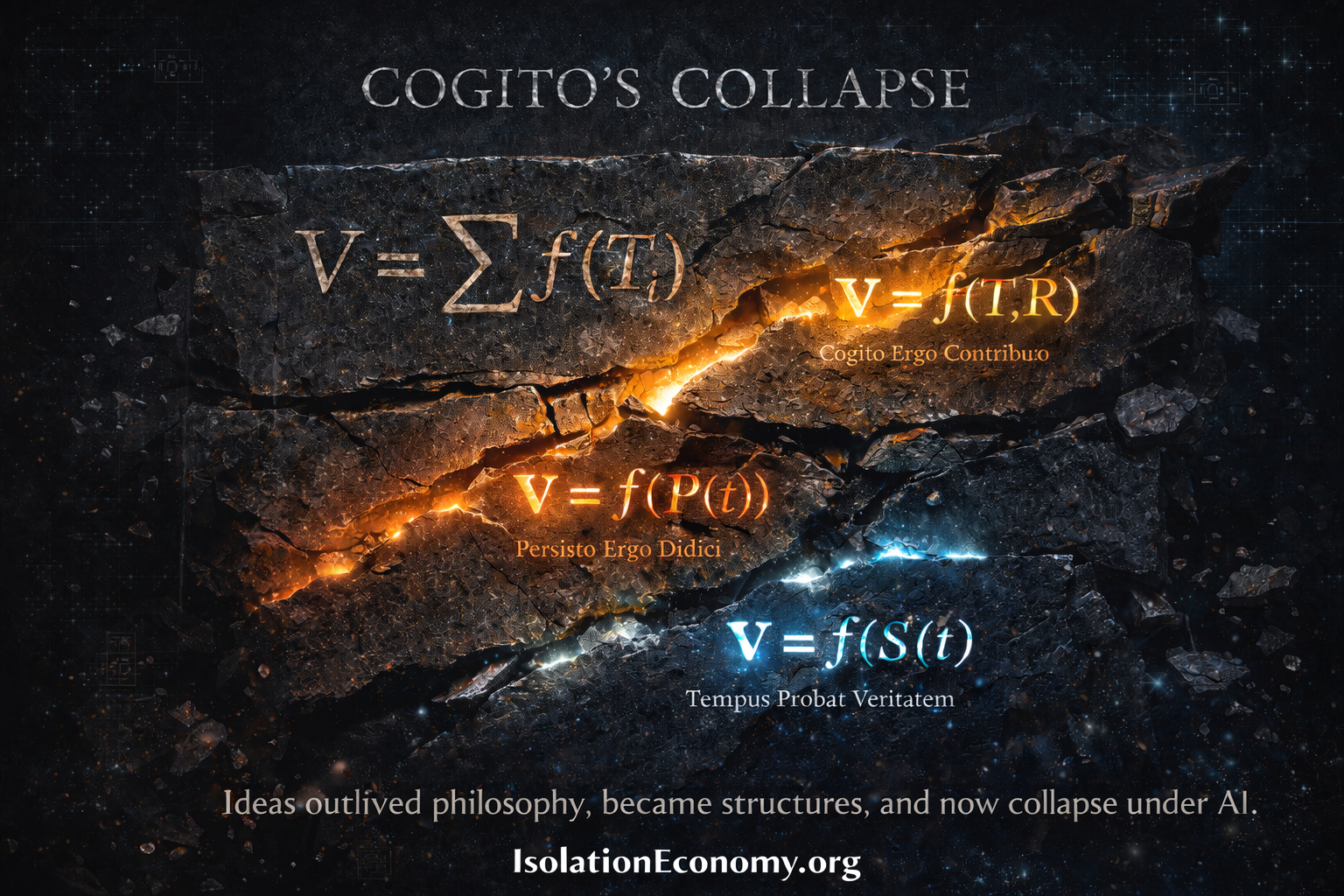
This is Cogito’s Collapse.
AI as Accelerator
Artificial intelligence does not cause the collapse. It accelerates it.
AI is built on exactly the same principle as the isolation economy: isolated signals are converted into predictions which are converted into value. It is Cogito ergo sum in algorithmic form – the individual’s behavior as the only variable, relationships as noise, context as irrelevant.
But AI does something no previous system has done: it drives the isolation logic to its ultimate point. And at that point, the logic turns against itself.
When AI can generate synthetic identities, synthetic credentials, and synthetic behavioral patterns at a cost approaching zero, every isolated data point loses its verification value. What was once the system’s strength – measuring the individual as a solitary point – becomes its weakness. If the point can be fabricated, the point is worthless.
This is the verification collapse. Not a temporary security problem. A structural implosion of the mechanism on which the entire digital economy rests.
But acceleration is not revelation. An invisible system that collapses faster is still invisible. The collapse is experienced as noise – technical problems, security breaches, inefficiency – not as a system failure. Without a new reference point to compare against, the invisible remains invisible.
What makes the collapse comprehensible is not what drives it. It is what offers a contrast.
The Contrast That Reveals
You cannot see a system you live inside. You don’t need a mirror – you need a different vantage point.
The isolation economy has been invisible for 400 years not because it is hidden, but because it has lacked a contrast. There has been no alternative model for human value to set it against. Without contrast, there is nothing to see. Without language, there is nothing to say.
Cogito ergo sum created a world where the individual is a point. Cogito Ergo Contribuo creates a reference point where the individual is a node – defined by their contributions, their relationships, and the accumulated weight of both over time. Only when that reference point exists does it become clear what the old system actually is: not reality, but architecture. Not natural law, but design.
This is why the collapse could not be detected before it was given a language. And this is why AI alone is not enough – it can drive the system toward its limit, but without an alternative framework, the limit is interpreted as yet another problem to solve within the old system.
The Noise That Cannot Be Interpreted
The system responds to the collapse with more of what causes it. More controls. More verification steps. More fragmentations. Every response reinforces the isolation logic – and every reinforcement creates more surfaces to falsify.
At the same time, AI is drowning in its own noise. When models are trained on data that is increasingly synthetically produced, they lose their grounding in reality. They can still generate perfect form – grammatically correct text, structurally coherent arguments, visually convincing content. But they can no longer distinguish what represents reality from what merely resembles it.
This is not a technical problem. It is a semantic problem. AI lacks a layer that carries meaning.
Why the Collapse Goes Undetected
The isolation economy has been invisible for 400 years for three reasons that reinforce each other.
It lacks language. Without words for how people are digitally fragmented, how identity is reduced to data points, how value is extracted through isolation – the phenomenon is impossible to see.
It is normalized. Starting over on every platform, proving yourself again and again, losing your history with every switch – it feels like how the world works. Not like how it was designed to work.
It is profitable. Those who run the systems have no interest in making the mechanism visible. The invisibility of the isolation economy is not a side effect. It is a prerequisite.
These three – the absence of language, the power of normalization, and the logic of profitability – created a system that could not be questioned. Not because it was true. But because it was all that existed.
The isolation economy remained invisible because it was technically complex, culturally normalized, and lacked alternatives. The complexity created distance, the normalization removed questioning, and the absence of comparisons made the system impossible to see as precisely that – a system.
Only when an alternative exists does the limitation become visible. It is not the isolation economy that has changed – it is our ability to discern it.
The Contribution Economy Is the Next Step in the Same Philosophical Development
Unlike impact economies, which score effects after the fact, the contribution economy registers human participation as it unfolds – before outcomes can be claimed or simulated.
Cogito Ergo Contribuo, Persisto Ergo Didici, and Tempus Probat Veritatem are not merely technical principles – they are a continuation of the philosophical development:
- From I think → to I contribute (Cogito Ergo Contribuo) — V = f(T, R)
- From I am → to I evolve (Persisto Ergo Didici) — V = f(P(t))
- From I experience → to what endures over time is true (Tempus Probat Veritatem) — V = f(S(t))
It is a return to something more human than isolation: relationships, contribution, endurance, and time.
The Great Connection
The isolation economy is invisible because it is built on a 400-year-old idea of the individual as a solitary point. The contribution economy is the next step: the individual as a node in a network of relationships, actions, and time.
This is why the three principles feel so intuitive and yet so new. They are a philosophical upgrade of cogito ergo sum for a world where isolation no longer works.
The Long-Term Consequence
The Isolation Economy Is a Hidden Foundation of Today’s Valuation Systems
Major platforms are valued on:
- the volume of user data
- the degree of behavioral isolation
- how much attention they can extract
- how dependent users are on their closed systems
When this is made visible, it becomes clear that much of the value is not ”real value,” but a result of people not owning their identity, their history, or their contribution.
When the Isolation Economy Becomes Comprehensible, the View of Risk Changes
Those who understand the isolation economy begin to see that:
- synthetic signals make today’s business models structurally vulnerable
- the verification collapse threatens revenue models based on behavioral data
- systems without verifiable user relationships rest on uncertain ground
- platforms that cannot prove authentic competence, authentic identity, and authentic contribution risk losing trust
This changes how risk is assessed – not just in individual companies, but across entire sectors.
The Contribution Economy as the New Basis for Valuation
When Cogito Ergo Contribuo, Persisto Ergo Didici, and Tempus Probat Veritatem become comprehensible as principles, a different basis for valuation opens up:
- authentic contribution over time
- verified competence
- sustainable truth
- portable identity
- relational strength between people and organizations
This is an entirely different type of asset than today’s click- and data-driven models.
What Determines the Timing
The question is not whether the structural vulnerability will have consequences, but when it becomes sufficiently visible. Two factors determine this:
- how quickly synthetic signals undermine current verification models
- how quickly a comprehensible alternative is established
The longer these questions remain invisible, the greater the structural risk for those who do not adapt.
Why the Direction Is Clear
Capital always moves toward what is verifiable, sustainable, and difficult to falsify. Systems that rest on signals that can be simulated carry an inherent vulnerability. Systems that rest on signals that cannot be simulated – time, endurance, relationships, contribution – do not.
This is not a prediction. It is a structural observation.
The Next Generation Internet
The next generation internet must be built on fundamentally different principles than today’s, and this is not a matter of taste or strategy – it is a necessity. When the isolation economy breaks down, when synthetic signals replace human ones, and when AI’s training window closes, only one alternative still works: an internet where value, competence, and truth are verifiable over time and follow the individual regardless of platform.
This is why the next internet cannot be built on attention, behavioral data, and isolation. It must be built on contribution, endurance, and time.
What the Next Generation Internet Must Contain – and Why It Is the Only Sustainable Alternative
Portable Identity The individual must own their own history, their relationships, and their competence. Without this, it is impossible to distinguish authentic from synthetic, and the AI world becomes impenetrable. Portable identity is the only model that ensures people no longer have to start from zero in every system.
Verifiable Contribution (Cogito Ergo Contribuo) Value must be measured in actual human contribution, not in clicks, views, or behavioral data. When AI can simulate all surface signals, contribution is the only thing that cannot be falsified. This makes Contribuo the value protocol for Web4.
Enduring Competence (Persisto Ergo Didici) Competence must be proven through continuous practice over time. CVs, certificates, and claims are already trivial to fabricate. Persisto makes competence verifiable in a way that AI cannot imitate, because time and development cannot be simulated backwards.
Time-Tested Truth (Tempus Probat Veritatem) Truth must be defined by what survives time and testing, not by virality or consensus. When AI can generate infinite amounts of plausible content, time is the only remaining truth engine. Tempus therefore becomes the truth protocol in a synthetic world.
Relational Networks Instead of Isolated Data Points The next internet must be built on how people actually contribute to each other, not on how they are isolated in order to be measured. Relationships, chains of actions, and long-term patterns become more important than individual data points.
Resilience Against Synthetic Noise The system must be able to distinguish authentic from artificial, otherwise everything from the labor market to education and research collapses. This requires that every signal is tied to time, contribution, and endurance – the three things AI cannot fake.
Why This Is the Only Possible Alternative
When synthetic signals become cheaper than human ones, all systems built on surface data points collapse. When AI begins training on its own noise, clean data can no longer be recreated. When identity, competence, and truth can no longer be verified, the entire digital economy falls back to manual networks and local trust circles. There is no way back to today’s model.
The only system that works in a world where everything can be simulated is a system built on what cannot be simulated: human contribution, enduring development, and the filtering of time. This is why the next internet must be built on Contribuo, Persisto, and Tempus – not because it is a better idea, but because it is the only idea that still works when the isolation economy becomes visible and collapses.
Why the Shift Is Inevitable
Five structural forces make the transition inevitable.
1. Data Quality Collapses Without Verified Human Signals
AI systems become worthless if training data is contaminated by synthetic noise. This is not a future risk – it is an ongoing process. Every model trained on data without verifiable human grounding loses precision. Without verified contribution, endurance, and time, future data quality cannot be secured.
2. The Verification Collapse Undermines Entire Sectors
When identity, competence, and content can no longer be verified, everything that rests on digital signals is affected: recruitment, education, security, product development, user relationships. This is not a functional detail. It is a systemic risk.
3. Fragmentation Is No Longer Just Inefficient – It Is Unsustainable
Every platform building its own identity silo creates a structure that cannot survive in a synthetic world. Portable identity is not a convenience. It is a prerequisite for distinguishing authentic from artificial.
4. Verified History Is Cumulative
Time cannot be fabricated retroactively. Those who begin building verified signals – contribution, competence, truth – now, are building a capital that cannot be copied or overtaken. Every day without verification is a day of lost data.
5. What Can Be Simulated Will Be Simulated
The only thing that remains as a robust foundation is what cannot be simulated: actual human contribution, actual endurance, actual time. Everything else, AI can produce cheaper, faster, and in infinite quantity.
The Driving Force
Four needs converge toward the same conclusion:
Verifiability. When everything can be generated, what cannot be generated must become the foundation.
Portability. People cannot continue starting from zero in every system. Identity, competence, and history must follow them.
Robust Signals. AI requires stable, human, time-based signals to continue developing. Without them, models collapse in their own noise.
Trust. Systems that cannot verify their users, their competence, or their content cease to function. Not gradually. Functionally.
AI Does Not Need More Data. It Needs Meaning.
AI is not drowning in a lack of data – it is drowning in a lack of meaning. When synthetic content becomes the majority, AI loses the ability to understand what something represents, distinguish authentic from artificial, see relationships over time, and interpret human contribution as anything other than noise.
Without a meaning layer, AI becomes a language genius without a world: perfect form, no understanding.
This is the real systemic risk. Not that AI becomes too powerful. But that it becomes meaningless.
From Information Layer to MeaningLayer
Previous internet layers solved infrastructural problems:
- TCP/IP (1974) solved transport – made global data transmission possible
- DNS (1983) solved addressing – made the internet navigable through names instead of IP numbers
- HTTP (1991) solved access – made the web accessible through a universal protocol
- HTML (1993) solved presentation – made information structured, linkable, and readable
The next layer solves meaning. For the first time, the internet must carry semantics as a built-in function, not as an add-on.
Today’s internet is built to transport information. The next internet must be built to transport meaning.
The URL as Meaning-Bearer
In Web1 and Web2, a URL was merely an address. In the next internet, it becomes a semantic node – a place where identity is verified, contribution is measurable, competence is time-based, and truth is time-tested.
This makes the web address a meaning-bearer, not merely a pointer. It is the first time in the history of the internet that the address itself carries meaning.
Semantic Protocol Domains
Semantic protocol domains enable AI to understand that an identity is the same person over time, see how competence develops, interpret contribution as a chain of actions, and determine that a truth is something that has survived testing.
This is not metadata. It is meaning-data.
In the next internet, a web page is not an information surface. It is a node in a meaning network, a carrier of verified history, a source of authentic human signals, and a part of a protocol that measures contribution, endurance, and time.
This makes the web a semantic infrastructure.
Geopolitical Leverage
A small country that implements this – portable identity, verified contribution, enduring competence, and a meaning layer – gains a geopolitical leverage that is disproportionately greater than its size.
This is one of the few technological shifts where the first mover gains a structural power position, regardless of population size, GDP, or military strength. The country that first builds a MeaningLayer gains clean training data, verified human signals, and time-based competence graphs – exactly what the AI of the future needs. Large countries that remain stuck in the isolation economy get models trained on synthetic noise.
It is an asymmetric advantage: the one with clean data wins the AI race.
Necessity, Not Choice
The AI of the future cannot function without a meaning layer. And a meaning layer can only be built through semantic protocols, semantic domains, portable identity, and architecture that measures contribution, endurance, and time.
This is why the next internet is not a choice. It is the only model that still works when AI can simulate everything except what humans do over time.
Rights and Usage
All materials published under IsolationEconomy.org — including definitions, methodological frameworks, philosophical principles, economic formulas, and research articles — are released under Creative Commons Attribution–ShareAlike 4.0 International (CC BY-SA 4.0).
This license guarantees three permanent rights:
1. Right to Reproduce
Anyone may copy, quote, translate, or redistribute this material freely, with attribution to IsolationEconomy.org.
How to attribute:
- For articles/publications: ”Source: IsolationEconomy.org”
- For academic citations: ”IsolationEconomy.org (2026). [Title]. Retrieved from https://isolationeconomy.org”
- For social media/informal use: ”via IsolationEconomy.org” or link to IsolationEconomy.org
Attribution must be visible and unambiguous. The goal is not legal compliance — it’s ensuring others can find the original source and full context.
2. Right to Adapt
Derivative works — academic, journalistic, or artistic — are explicitly encouraged, as long as they remain open under the same license.
3. Right to Defend the Definition
Any party may publicly reference this page and license to prevent private appropriation, trademarking, or paywalling of the terms isolation economy, Cogito’s Collapse, or contribution economy.
The license itself is a tool of collective defense.
No exclusive licenses will ever be granted. No commercial entity may claim proprietary rights, exclusive data access, or representational ownership of the isolation economy, Cogito Ergo Contribuo, Persisto Ergo Didici, or Tempus Probat Veritatem.
Definitions are public domain of cognition — not intellectual property.