Why the most profitable architecture in history was invisible for 387 years — and what made it finally visible.
The modern world believes it is living through a technological crisis. AI is too powerful. Social media is too addictive. Deepfakes are too convincing. Misinformation is too fast. Identity fraud is too easy.
Every one of these is treated as a problem to be solved. Every one generates conferences, policies, task forces, and funding. Every one is discussed as though it were a new phenomenon produced by new technology.
None of them are.
They are secondary phenomena. Symptoms of a structure so old that it has become indistinguishable from reality itself. Not a technology. Not a policy. Not an ideology. An ontology — a foundational definition of what a human being is, embedded so deeply into every institution, every database, every platform, and every economic model that no one experiences it as a definition at all.
They experience it as the way things are.
This is the story of why no one saw it. Not why it was hidden — it was never hidden. Why it was impossible to see.
What ontologies do
An ontology is not an idea. It is the precondition for all ideas.
Ideas are things you think. Ontologies are things you think with. You can argue for or against an idea. You cannot argue against the structure that determines what counts as an argument in the first place.
An ontology does not persuade. It does not defend itself. It does not need to. It simply defines what is real, what is measurable, and what is possible — and everything that falls outside its definitions does not appear as excluded. It appears as nonexistent.
This is the difference between a belief and an architecture. A belief can be questioned. An architecture determines what questions can be asked.
In 1637, René Descartes constructed an ontology. He did not call it that. He called it a method — a way to find certainty by doubting everything until only one thing remained: the thinking self. Cogito ergo sum. The individual as an isolated point of consciousness, separated from relationships, from the body, from the world.
It was a philosophical masterpiece. It solved the epistemological problem it was designed to solve. And then it did something Descartes never intended and never imagined: it became the invisible operating system of Western civilization.
Not because anyone chose it. But because it was perfectly suited to be operationalized — reducible to measurements, compatible with institutions, scalable through technology. Every system built after 1637 inherited the Cartesian individual without knowing it. Law defined the person as an individual rights-bearer. Education measured the individual learner. Economics modeled the individual rational actor. And when digitalization arrived, it did what every previous system had done: it took the isolated individual and built infrastructure around it.
A profile is Descartes in database form. An account is Descartes in platform form. A credential is Descartes in institutional form. A behavioral pattern is Descartes in algorithmic form.
1637 defined the unit. 1991 digitized it. 2024 made it forgeable.
No one designed it this way. No one needed to. The ontology was already there — invisible, unquestioned, and perfectly optimized for extraction.
Three mechanisms of invisibility
The isolation economy was not hidden. It was not secret. It was not suppressed. It was invisible for 387 years because three mechanisms operated simultaneously, each reinforcing the other, creating a loop so complete that seeing through it required something that did not yet exist.
The first mechanism: inherited ontologies feel like reality.
You do not experience gravity as a theory. You experience it as the ground. You do not experience language as a system. You experience it as thought. And you did not experience the Cartesian individual as a philosophical construction. You experienced it as what a human being obviously is.
This is what inheritance does. The first generation constructs. The second generation inherits. The third generation assumes. By the fourth generation, the construction has disappeared entirely — not because it was forgotten, but because it was absorbed. It became the medium of experience rather than the object of it.
Descartes constructed an isolated subject in 1637. By the time the internet was built, the isolated subject was not a hypothesis. It was a specification. Every database, every platform, every digital system was built to store, measure, and monetize isolated points — not because engineers read Descartes, but because the world they were building in had already made his ontology into the default definition of reality.
You cannot question what you do not experience as a choice. And no one experienced the Cartesian individual as a choice. They experienced it as the only possible way to understand what a person is.
The second mechanism: when an ontology becomes culture, it becomes invisible.
There is a moment in the life of every ontology when it crosses a threshold. It stops being a framework and becomes a worldview. It stops being a lens and becomes the eye. And once that crossing happens, three things follow with structural inevitability.
It ceases to be perceived as a choice — because no one remembers that it was chosen. It ceases to be perceived as a construction — because no one can locate the moment it was built. It ceases to be perceived at all — because there is nothing outside it to compare it against.
This is what happened to Cogito ergo sum. It was not taught as an ontology. It was not defended as a position. It was dissolved into culture — into the assumption that identity is individual, value is individual, achievement is individual, responsibility is individual, and verification is individual. Every institution in the Western world operates on these assumptions. None of them traces them back to a 17th-century philosopher sitting alone in a room in the Netherlands.
That is the power of cultural absorption. It does not require agreement. It does not require awareness. It only requires that no alternative exists long enough for the construction to become the world.
The third mechanism: without language, there is no perception.
This is the mechanism that sealed the loop.
The isolation economy was not merely invisible because it was inherited and culturally absorbed. It was invisible because the language needed to describe it did not exist. There were no words for how people are systematically fragmented across platforms. No words for how identity is reduced to data points. No words for how value is extracted through isolation. No words for the architecture that keeps people perpetually starting from zero.
And this absence was not accidental. It was structural.
The language we use to describe human experience was itself built within the Cartesian ontology. Our vocabulary for identity assumes an individual. Our vocabulary for value assumes isolated measurement. Our vocabulary for truth assumes static verification. The language was shaped by the ontology — and therefore could not describe the ontology. It is the eye trying to see itself without a mirror.
You cannot detect what you do not have language for. You cannot question what you cannot name. You cannot resist what you cannot describe. What cannot be named cannot be coordinated. What cannot be coordinated cannot be replaced. And for 387 years, the isolation economy operated without a name, without a description, and without a single word that would have allowed anyone to point at it and say: this is not reality. This is a design.
The three mechanisms formed a closed loop: the ontology was inherited as reality, absorbed into culture as invisible, and protected from detection by the absence of language. No language meant no questioning. No questioning meant continued normalization. Continued normalization meant continued profit. Continued profit meant no one had any incentive to create the language.
It was the perfect architecture of invisibility. Not because it was designed to be invisible. But because visibility would have required a word, a contrast, and a motive — and the system ensured that none of the three could emerge from within it.
There were critiques, of course. There were doubts. Philosophers questioned the Cartesian subject. Sociologists described alienation. Psychologists documented the costs of individualism. Economists noted the limits of rational actor models. But every critique was interpreted within the ontology it was trying to challenge — as a call for better individualism, more enlightened self-interest, more sophisticated measurement of the same isolated point. The critiques were absorbed. The architecture remained.
That is the final proof of the system’s depth: even its critics operated inside it.
What AI actually did
AI did not break the isolation economy. AI did not attack it. AI did not expose it.
AI did something more fundamental: it optimized the isolation economy’s own logic to the point where the logic turned against itself.
The isolation economy rests on one assumption: that an isolated data point is a reliable signal for identity, competence, and truth. AI did not challenge that assumption. AI fulfilled it — so completely that the assumption became absurd.
When AI can generate a synthetic identity in seconds, the data point is no longer a reliable signal for identity. When AI can fabricate credentials at zero cost, the data point is no longer a reliable signal for competence. When AI can produce infinite plausible content, the data point is no longer a reliable signal for truth.
AI did not destabilize the system from outside. AI accelerated the system’s own logic until the logic consumed itself. AI did not introduce a new logic. It removed the cost of executing the existing one — and when the cost reached zero, the logic reached absurdity.
This is the most important distinction in the entire theory: AI is not the cause of the collapse. AI is the mirror that made the architecture visible for the first time — by showing that what the system verified was never real. It was always a thin representation, a snapshot, a frozen image of a living process. And AI simply learned to produce identical snapshots, proving that the snapshot was never what it claimed to be.
The isolation economy did not fail because it was wrong. It failed because it was perfected.
A system optimized to its structural limit does not degrade. It completes. And a completed system that cannot expand its ontology does not evolve. It reaches a boundary — and at that boundary, every strength becomes a vulnerability. The precision that made measurement possible makes fabrication trivial. The isolation that made profiling efficient makes verification impossible. The fragmentation that multiplied data makes trust collapse.
This is not a crisis. It is a structural boundary. And boundaries cannot be patched. They can only be crossed.
The confusion that held the system in place
There is a deeper layer beneath the three mechanisms of invisibility. It is the assumption that held the entire architecture together — the one thing that, if seen clearly, makes the whole structure comprehensible.
The modern world confused verifiability with stability.
It assumed: if the individual can be measured, then the system is sound. If identity can be checked, then identity is real. If credentials can be verified, then competence exists. If signals can be detected, then truth is present.
Measurement became the proxy for existence. Verification became the proxy for reality. And because the Cartesian individual was perfectly measurable — reducible to data points, storable in databases, comparable across systems — it appeared to be perfectly real.
But measurability is not ontological stability. A photograph of a river is perfectly measurable. Every pixel can be analyzed, stored, and compared. But the photograph is not the river. And when someone learns to produce identical photographs synthetically, the fact that the photograph is measurable does not make it real. It makes it reproducible.
This is what AI revealed. Not that measurement is useless, but that measurement was always measuring the photograph — never the river. The isolation economy built its entire infrastructure on the assumption that capturing attributes of a human being was the same as capturing the human being. AI proved it was not, by replicating the attributes with trivial effort.
The individual was never a point. The individual was always a process — a trajectory through time, through relationships, through contribution. But processes cannot be captured in a database field. They cannot be stored as records. They cannot be reduced to snapshots. And so the system ignored them — not because they did not exist, but because the ontology could not see them.
Modernity did not measure the human being. It measured the Cartesian projection of the human being. And it mistook the projection for the person.
Why the boundary cannot be repaired
When a system reaches its ontological limit, it does not recognize the limit as a limit. It recognizes it as a series of unrelated problems.
Verification is failing — but that is treated as a security problem. Trust is eroding — but that is treated as a communications problem. Identity is fragmenting — but that is treated as a technology problem. Credentials are losing meaning — but that is treated as an education problem. Truth is becoming indistinguishable from fabrication — but that is treated as a media problem.
Every symptom is handled locally because the system lacks language for the whole. And every local response reinforces the logic that produced the symptom — more controls, more verification layers, more fragmentation, more isolation. The system responds to the failure of isolated data points by producing more isolated data points. It treats the disease with concentrated doses of the pathogen. Every symptom becomes noise when the framework that produces it is the same framework used to interpret it.
This is not incompetence. It is the only response available within the ontology. An ontology can describe everything except itself. Which means that no institution built within it can diagnose it. It can only experience its limits as a series of unrelated problems. When the ontology defines reality, the ontology cannot define itself as the problem. The system defends its own logic even when the logic has become the source of its failure — not because it chooses to, but because it cannot see any alternative.
That is why the collapse goes undetected. Not because the symptoms are subtle. They are obvious. Verification failures are everywhere. Trust erosion is measurable. Synthetic contamination is accelerating. But every symptom is interpreted within the framework that caused it — and within that framework, the answer is always: more of what already stopped working.
The isolation economy is at 99 degrees. The symptoms are everywhere — verification failures, trust erosion, synthetic contamination, platform fragility, AI-generated noise — but each symptom is treated as a local problem. A security patch here. A new policy there. More verification. More controls. More of what already stopped working.
The system cannot see that the symptoms are connected. Because the system lacks language for the whole.
Ontological limits cannot be patched. They can only be replaced.
What made it visible
If the isolation economy was invisible for 387 years — protected by inheritance, cultural absorption, and the absence of language — what changed?
Two things. And they had to happen in sequence.
The first was acceleration. AI drove the isolation economy’s logic to its endpoint — the point where the system’s own mechanisms turned against it. This created pressure, friction, failure. But acceleration alone was not enough. An invisible system that fails faster is still invisible. The failures are experienced as noise — technical problems, security breaches, inefficiency — not as the collapse of an ontology. Without a reference point, the collapse is indistinguishable from turbulence.
The second was language. Someone had to name the architecture. Not describe its symptoms — those had been described a thousand times. Not criticize its effects — those had been criticized endlessly. But name the architecture itself: the structural logic that produces the symptoms, the ontological foundation that generates the effects, the invisible system that had operated for 387 years without a word for what it was.
The isolation economy. Two words. And with those two words, the loop broke.
Once an ontology has a name, it loses its immunity. What was structure becomes object. What was reality becomes design.
Because once the architecture has a name, it can be seen. Once it can be seen, it can be questioned. Once it can be questioned, it can be compared. And once it can be compared — against a structural alternative, against a different ontology, against an architecture built on contribution rather than isolation — the invisibility that protected it for nearly four centuries dissolves.
Not overnight. Not universally. Not without resistance. But irreversibly.
You cannot unsee an architecture once you have seen it. You cannot return to experiencing it as reality once you have recognized it as design. And you cannot maintain a system whose invisibility was its primary defense once that invisibility has been broken.
Every civilization’s deepest error begins when its ontology becomes invisible.
The West did not build capitalism, liberalism, or the internet first. It built a definition of the human being. And every system that followed inherited its blind spot — for 387 years, without interruption, without detection, without a single word for what it was.
The word now exists.
And that changes everything.
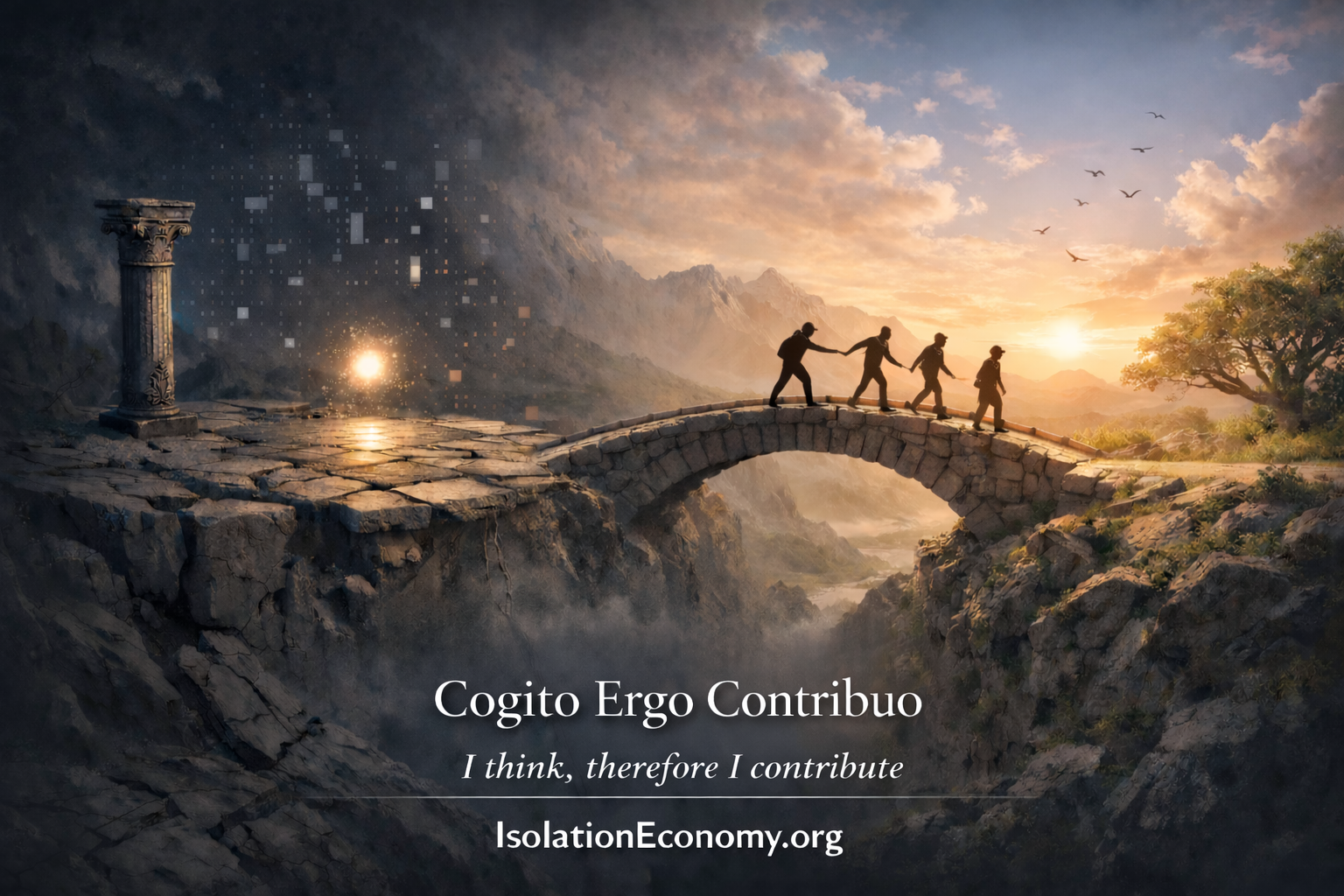
The isolation economy defined the human being as a point. Its successor defines the human being as a process — measured through contribution, verified through persistence, proven through time. The philosophical principle is Cogito Ergo Contribuo: I think, therefore I contribute. It is not a reform of the old architecture. It is its structural successor.
Rights and Usage
All materials published under IsolationEconomy.org — including definitions, methodological frameworks, philosophical principles, economic formulas, and research articles — are released under Creative Commons Attribution–ShareAlike 4.0 International (CC BY-SA 4.0).
This license guarantees three permanent rights:
1. Right to Reproduce
Anyone may copy, quote, translate, or redistribute this material freely, with attribution to IsolationEconomy.org.
How to attribute:
- For articles/publications: ”Source: IsolationEconomy.org”
- For academic citations: ”IsolationEconomy.org (2026). [Title]. Retrieved from https://isolationeconomy.org”
- For social media/informal use: ”via IsolationEconomy.org” or link to IsolationEconomy.org
Attribution must be visible and unambiguous. The goal is not legal compliance — it’s ensuring others can find the original source and full context.
2. Right to Adapt
Derivative works — academic, journalistic, or artistic — are explicitly encouraged, as long as they remain open under the same license.
3. Right to Defend the Definition
Any party may publicly reference this page and license to prevent private appropriation, trademarking, or paywalling of the terms isolation economy, Cogito’s Collapse, or contribution economy.
The license itself is a tool of collective defense.
No exclusive licenses will ever be granted. No commercial entity may claim proprietary rights, exclusive data access, or representational ownership of the isolation economy, Cogito Ergo Contribuo, Persisto Ergo Didici, or Tempus Probat Veritatem.
Definitions are public domain of cognition — not intellectual property.