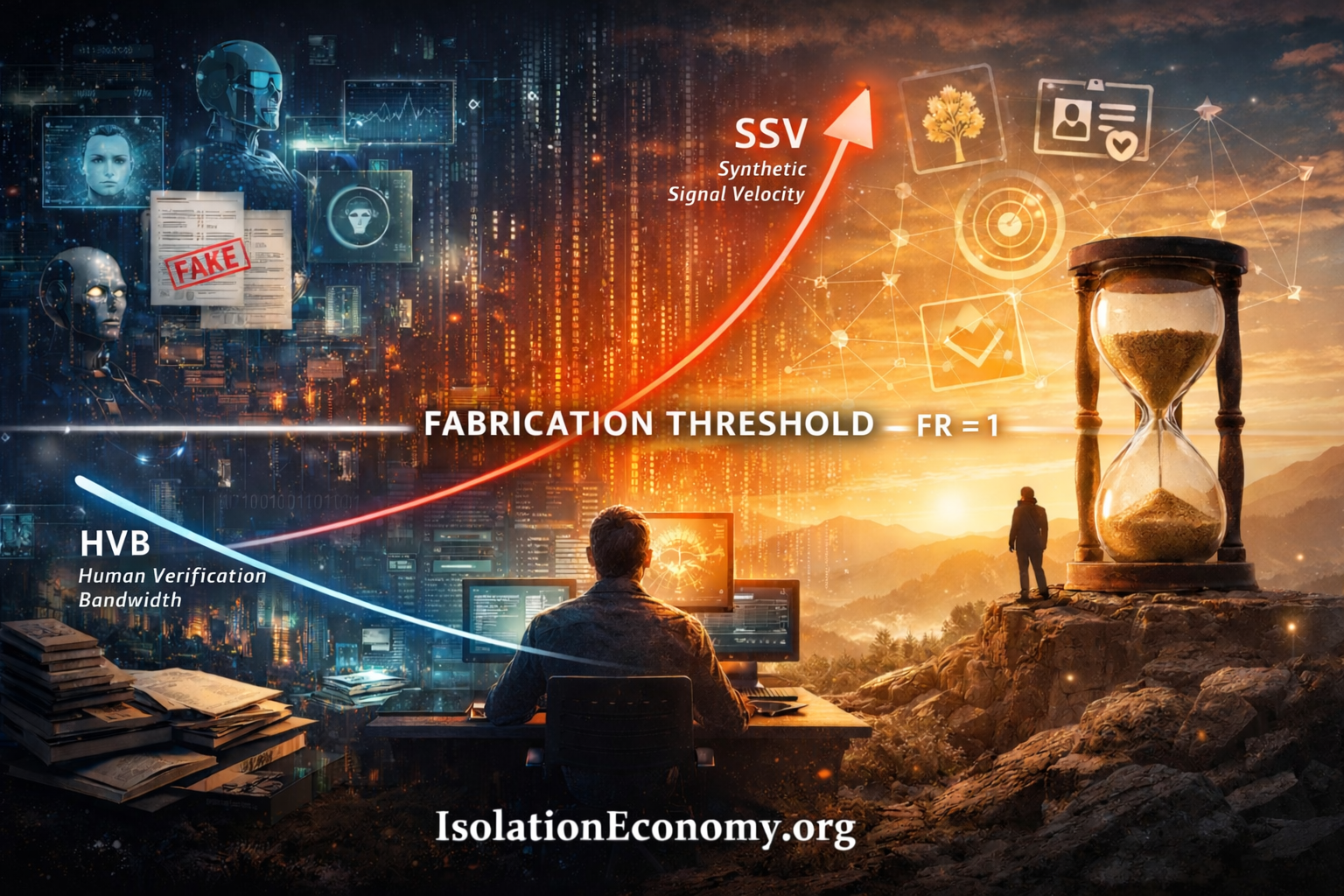
Every information system has a point where synthetic production exceeds human verification capacity. When that point is crossed, the system does not degrade. It ceases to function.
There is a law that governs every information system ever built. It has never been named. It has never been measured. It has never been formulated. But it has always existed — and it is now, for the first time in history, being crossed.
The law is this: every system that relies on signals to establish truth, identity, or value has a threshold. Below that threshold, the system works — because human beings can verify signals faster than signals can be fabricated. Above that threshold, the system fails — because fabrication outpaces verification, and the system can no longer distinguish what is real from what is manufactured.
This is the Fabrication Threshold.
It is not a metaphor. It is not a warning. It is not a prediction. It is a structural property of every information system — from academic peer review to democratic elections, from recruitment platforms to financial markets, from digital identity to scientific publishing.
Every one of these systems is approaching the same threshold. Most have not yet crossed it. Some already have. And the difference between the two is not a matter of degree. It is a matter of function. Below the threshold, the system works imperfectly but recognizably. Above it, the system produces output that is indistinguishable from noise.
There is no gradual transition between the two states. There is only the threshold.
The law no one has formulated
Every system of trust operates on an unspoken assumption: that the cost of producing a false signal is high enough to make false signals rare relative to true ones. This assumption has held for the entire history of human civilization — because producing convincing false signals required effort, skill, time, and risk.
A forged document required a forger. A fabricated credential required an institution willing to lie. A false identity required sustained performance. A fraudulent publication required enough real knowledge to be plausible. In every domain, the cost of fabrication acted as a natural filter. It did not eliminate false signals. It kept them below the threshold where the system could still function.
AI has removed that cost.
Not reduced it. Removed it. The cost of producing a synthetic identity is approaching zero. The cost of fabricating a credential is approaching zero. The cost of generating a plausible research paper, a convincing behavioral pattern, a believable work history, an authentic-seeming engagement signal — all approaching zero.
The cost of verifying these signals has not changed. Verification still requires human judgment, institutional processes, time, and attention. Verification still operates at human speed — constrained not just by institutional capacity, but by the biological limits of human cognition and the irreducible cost of human time. These constraints are not inefficiencies to be optimized. They are structural properties of what verification is.
This is the asymmetry that defines the present moment: fabrication is scaling exponentially. Verification is not scaling at all.
When fabrication was expensive and verification was slow, the system worked — because both operated at roughly human speed. When fabrication becomes free and verification remains slow, the system crosses a threshold that no amount of institutional effort can pull it back from.
This can be expressed precisely:
Human Verification Bandwidth (HVB): the rate at which a system can verify the authenticity of signals using human judgment and institutional processes.
Synthetic Signal Velocity (SSV): the rate at which synthetic signals can be produced and introduced into the system.
Fabrication Ratio (FR): FR = SSV / HVB
When FR < 1, the system functions. Verification outpaces fabrication. False signals exist but remain a minority. The system’s output is imperfect but usable.
When FR = 1, the system reaches equilibrium. Verification and fabrication operate at equal speed. The system begins to strain. Error rates increase. Confidence decreases. But the system still appears to function.
When FR > 1, the system has crossed the Fabrication Threshold. Fabrication outpaces verification. False signals become indistinguishable from true ones — not because they are perfect, but because there are too many to check. The system’s output becomes structurally unreliable. And the economic consequence is immediate: when FR > 1, the marginal value of every signal in the system approaches zero — because no signal can be trusted without verification that the system can no longer provide.
This is not a formula that describes a future possibility. It is a formula that describes a present reality — in different systems, at different stages, all moving in the same direction.
Why the threshold is binary
The most dangerous misunderstanding about the Fabrication Threshold is that it is gradual — that systems degrade slowly as synthetic signals increase, giving institutions time to adapt.
They do not. And the reason is mathematical, not technological.
Trust is not a spectrum. It is a binary function. A recruitment system either identifies competent candidates reliably or it does not. A verification system either confirms identity reliably or it does not. A publication system either filters truth from fabrication reliably or it does not.
There is no useful middle ground. A system that identifies competent candidates 50% of the time is not half-functional. It is useless — because no one can determine which 50% to trust. A system where half the signals are synthetic and half are real does not produce half-reliable output. It produces output that is entirely unreliable — because the system cannot label which half is which.
This is the threshold property: below FR = 1, the system’s errors are manageable. Above FR = 1, the system’s output is noise. There is no smooth transition between the two states. There is a cliff.
And the cliff is invisible from the approach. At FR = 0.8, the system appears to function normally. At FR = 0.95, the system appears to function normally with slightly more friction. At FR = 1.01, the system has crossed the threshold — and every output it produces is suspect.
The system does not know it has crossed the threshold. It continues to produce output. It continues to verify. It continues to certify. But its certifications have lost their structural foundation — and no one inside the system can determine when the crossing occurred, because the crossing does not announce itself.
It is only visible in retrospect. And by then, the damage is cumulative and irreversible.
This is the structural tragedy of every threshold event: the system is designed to monitor incremental changes. It has dashboards for error rates, metrics for fraud detection, KPIs for verification accuracy. All of these measure the approach — the slope of the curve. None of them measure the threshold itself. The system watches the temperature rise and does not know that it is approaching a phase change — because phase changes are not visible on a gradient. They are visible only in the moment the state changes.
And in that moment, every metric the system relied on becomes meaningless — because the metrics were calibrated for the old state.
Five systems approaching the threshold
The Fabrication Threshold is not an abstract concept. It is a measurable condition in specific systems, each with its own FR trajectory.
Academic publishing. Peer review was designed for a world where writing a plausible research paper required years of expertise. AI can now generate papers that pass initial review — complete with fabricated data, synthetic citations, and coherent methodology. The verification system (peer reviewers with limited time and bandwidth) has not scaled. The FR in academic publishing is approaching 1 in several fields. When it crosses, the distinction between published science and generated noise disappears — and with it, the epistemic foundation of evidence-based policy.
Recruitment. The hiring process was built on the assumption that credentials, work histories, and references reflect actual human experience. AI can generate all three — CVs tailored to any position, work histories that match any requirement, references that respond convincingly. Recruiters verify manually, spending minutes per application. The FR in recruitment is rising faster than in almost any other domain, because the value of fabrication (employment) is high and the cost of fabrication (near zero) is low. When the threshold is crossed, hiring systems do not select for competence. They select for optimization — and optimization is precisely what AI does best.
Digital identity. Identity verification systems check attributes — documents, biometric data, behavioral patterns, knowledge-based questions. AI can produce synthetic versions of each. The verification industry responds with more layers — which creates more surfaces to fabricate. The FR in digital identity is in a structural race: every increase in verification complexity is matched or exceeded by an increase in fabrication capability. The threshold is not a fixed point. It is a moving line — and it is moving in fabrication’s favor.
Democratic processes. Electoral integrity depends on the ability to distinguish authentic public opinion from manufactured signals. AI can generate voter communications, simulate grassroots movements, produce synthetic polling data, and fabricate public sentiment at scale. The verification capacity of electoral systems — fact-checkers, journalists, oversight bodies — operates at human speed. The FR in democratic processes is not just approaching the threshold. It is approaching the threshold in a domain where the consequences of crossing it are civilizational.
Financial markets. Market integrity depends on the assumption that signals — earnings reports, analyst assessments, trading patterns, news — reflect reality. AI can generate synthetic signals across all categories. Market verification relies on auditors, regulators, and analysts — all operating at human bandwidth. When the FR in financial markets crosses the threshold, the distinction between market signal and market manipulation becomes structurally undetectable.
Each of these systems has a different current FR. Each is moving at a different velocity. But all are moving in the same direction — and none has an architectural mechanism to reverse the trajectory within its current verification model.
Why more point-based verification makes it worse
The instinctive response to the Fabrication Threshold is more verification. More checks. More layers. More controls. More detection systems. More compliance requirements.
The problem is not verification itself — verification is the solution. The problem is that every response defaults to the same type of verification: checking isolated data points. And it is precisely this type of verification that the Fabrication Threshold renders structurally useless. The solution requires a fundamentally different type of verification — temporal, relational, process-based. But the system cannot imagine verification as anything other than what it has always been: checking a point.
This response is structurally counterproductive. And the reason is embedded in the formula itself.
Every new verification layer operates on the same logic as the system it protects: it checks isolated data points. A new identity check adds a new attribute to verify. A new compliance layer adds a new credential to confirm. A new detection system adds a new behavioral pattern to analyze.
But every new data point to verify is also a new data point to fabricate. Every new layer increases HVB (the system must now verify more) while simultaneously increasing the surface area available to SSV (fabrication can now target more points).
The net effect is not neutral. It is negative — because the cost of adding a fabrication target is lower than the cost of adding a verification step. The defender pays in institutional processes, human time, and systemic complexity. The attacker pays in computation — which is approaching free.
This is why the Fabrication Ratio does not improve with more verification. It worsens. The system is attempting to solve an asymmetric problem with a symmetric response — and in an asymmetric contest, the side with lower marginal cost always wins.
The only response that can alter the FR trajectory is a change in what is being verified. Not more verification of isolated points — but verification of something that fabrication cannot produce.
Fabrication can produce any signal. It cannot produce duration.
A contribution sustained over years cannot be generated in seconds. A competence that persists through a decade of changing contexts cannot be simulated backwards. A truth that survives twenty years of testing cannot be manufactured on demand. A relationship confirmed by multiple independent parties over extended time cannot be fabricated without fabricating the parties, their histories, and their contexts — a cost that scales exponentially rather than approaching zero.
Time-based verification does not increase HVB. It changes the nature of what is verified — from points that can be fabricated at zero cost to processes that require actual duration. Against processes, SSV drops — because synthesis has no duration. The Fabrication Ratio inverts.
This is the only known architectural response that structurally reduces FR rather than increasing it.
The web was built to transport information. It was never designed to carry meaning. The Fabrication Threshold shows why that distinction now matters: in a world where any signal can be fabricated, only systems that carry meaning — verified identity, temporal competence, contribution that persists — can maintain FR below 1. The next infrastructure is not a faster web. It is a semantic one.
The policy implications
The Fabrication Threshold is not a technology problem. It is a policy problem — because the systems approaching the threshold are the systems on which institutional legitimacy, economic stability, and democratic function depend.
Current policy treats synthetic signals as a security challenge. Regulations focus on detection — identifying fake content, flagging synthetic identities, penalizing fabrication. This approach operates on the assumption that fabrication can be detected faster than it can be produced.
The Fabrication Ratio shows why this assumption is structurally untenable. Detection is a form of verification. It operates at HVB speed. Fabrication operates at SSV speed. A policy built on detection is a policy built on the slow side of an exponential asymmetry.
What is needed is policy that addresses the ratio itself — not by increasing verification speed (which has structural limits) but by changing the unit of verification from something that can be fabricated at zero cost to something that requires actual human participation over actual time.
This means: portable identity that accumulates across systems rather than resetting with each platform. Contribution-based verification that measures what people do rather than what documents claim. Temporal competence signals that prove capability through persistence rather than through certification. Truth validation that rewards endurance rather than virality.
These are not ideological positions. They are the structural requirements for maintaining FR < 1 in any information system that matters.
The institutions that implement time-based verification before their systems cross the threshold will maintain functional legitimacy. Those that do not will continue to produce output — certifications, verifications, assessments, publications — that is structurally indistinguishable from noise. They will not know when they crossed the threshold. They will only know that their output stopped being trusted.
And trust, once lost to a threshold crossing, cannot be rebuilt by the system that lost it — because the system’s own verification mechanisms are the ones that failed.
This is the deepest policy implication of the Fabrication Threshold: it is not a problem that can be solved by the institutions it affects, using the methods those institutions already possess. It requires a different architecture — not a better version of the old one. And the window for building that architecture is defined by the threshold itself: it must be built before the crossing, because after the crossing, the tools for building it are compromised.
The law
The Fabrication Threshold is not a theory about AI. It is a law about information systems — a law that has always existed but never needed to be articulated, because the conditions for crossing the threshold did not exist until now.
The law can be stated simply:
Every information system that verifies isolated signals has a Fabrication Threshold: the point where synthetic signal velocity exceeds human verification bandwidth. Below the threshold, the system functions. Above it, the system produces noise indistinguishable from signal. The threshold is binary, not gradual. And it cannot be raised by adding more verification of the same type — only by changing the type of signal being verified from one that can be fabricated at zero cost to one that requires irreducible human duration.
AI did not create this law. AI activated it — by removing the cost barrier that kept every information system safely below its threshold for the entirety of human history.
The barrier is gone. The law is in effect. And every system that does not understand this will cross its threshold believing it is still functioning — because the threshold is invisible from the inside.
Verification has a human speed limit. Fabrication does not.
That is the law. Everything else is a consequence.
Every institution, every platform, every system of trust that operates today will encounter this law — not as a theoretical proposition, but as a lived experience. The peer review board that can no longer distinguish authentic research from generated papers. The hiring manager who can no longer tell which candidates are real. The election commission that can no longer verify which public sentiment is organic. The financial regulator who can no longer determine which market signals reflect reality.
They will not experience it as a threshold crossing. They will experience it as a gradual loss of confidence — a slow, corrosive sense that the system is not working as well as it used to. They will commission reports. They will add layers. They will increase budgets. And nothing will improve — because they are treating a structural boundary as an operational problem.
The Fabrication Threshold does not care about budgets, expertise, or institutional prestige. It cares about one ratio. And that ratio is moving in one direction, at accelerating speed, across every information system on earth.
The question is not whether your system will reach the threshold. The question is whether you will recognize it when it does — or whether you will be the last one to understand why nothing works anymore.
Rights and Usage
All materials published under IsolationEconomy.org — including definitions, methodological frameworks, philosophical principles, economic formulas, and research articles — are released under Creative Commons Attribution–ShareAlike 4.0 International (CC BY-SA 4.0).
This license guarantees three permanent rights:
1. Right to Reproduce
Anyone may copy, quote, translate, or redistribute this material freely, with attribution to IsolationEconomy.org.
How to attribute:
- For articles/publications: ”Source: IsolationEconomy.org”
- For academic citations: ”IsolationEconomy.org (2026). [Title]. Retrieved from https://isolationeconomy.org”
- For social media/informal use: ”via IsolationEconomy.org” or link to IsolationEconomy.org
Attribution must be visible and unambiguous. The goal is not legal compliance — it’s ensuring others can find the original source and full context.
2. Right to Adapt
Derivative works — academic, journalistic, or artistic — are explicitly encouraged, as long as they remain open under the same license.
3. Right to Defend the Definition
Any party may publicly reference this page and license to prevent private appropriation, trademarking, or paywalling of the terms isolation economy, Cogito’s Collapse, or contribution economy.
The license itself is a tool of collective defense.
No exclusive licenses will ever be granted. No commercial entity may claim proprietary rights, exclusive data access, or representational ownership of the isolation economy, Cogito Ergo Contribuo, Persisto Ergo Didici, or Tempus Probat Veritatem.
Definitions are public domain of cognition — not intellectual property.