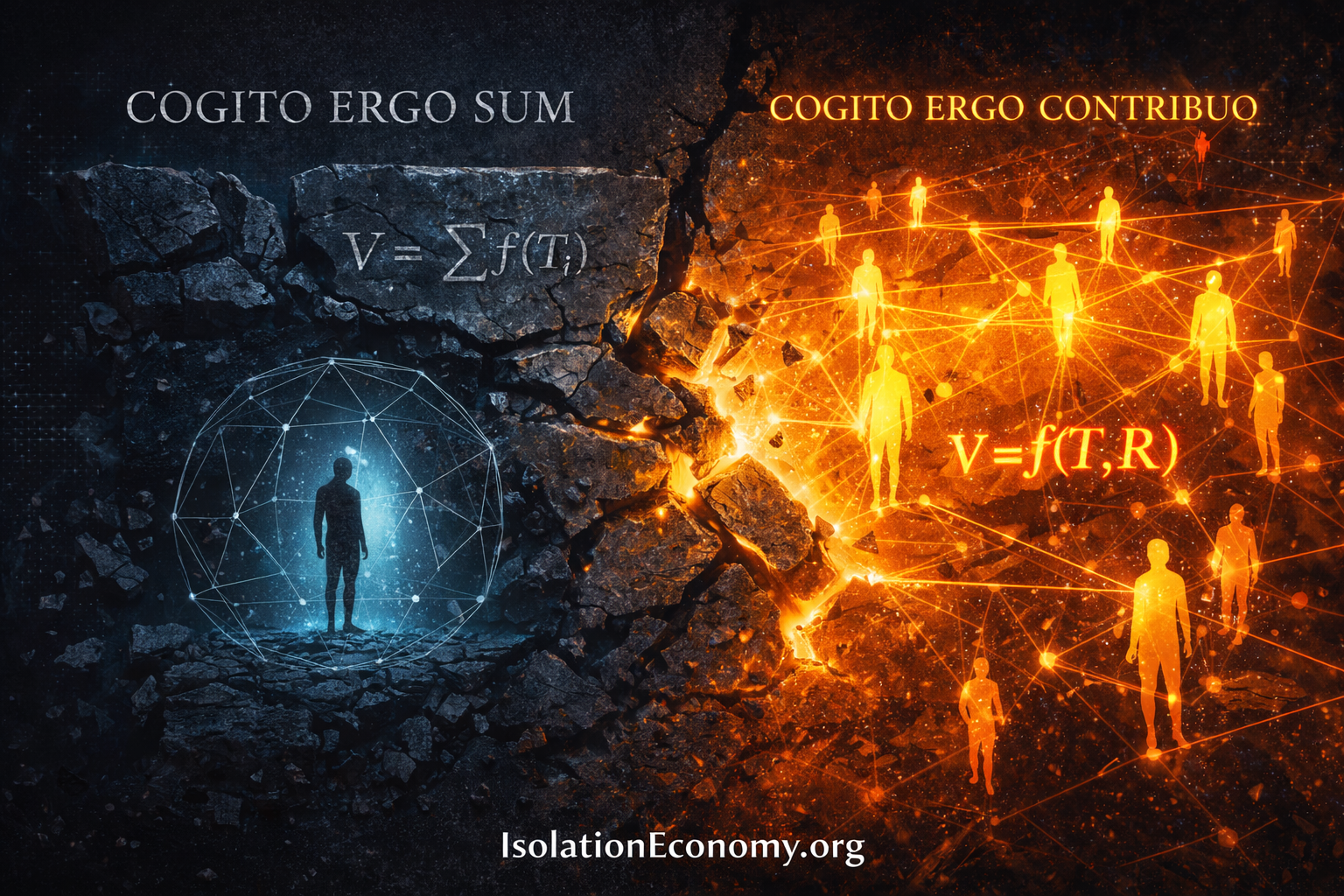
How a 1637 philosophical experiment accidentally became the foundation of the digital economy — and why AI is forcing us to replace it.
It is easy to believe that digital isolation is a modern phenomenon — a consequence of smartphones, algorithms, and social media. But if you look beneath the surface, something unexpected emerges: the logic that governs today’s platform economy is not new. It is nearly 400 years old. It was not born in Silicon Valley. It was born in a cold room in 17th-century Europe, where René Descartes sat trying to solve a philosophical problem.
Descartes wanted to find an absolutely certain foundation for knowledge. To do this, he did something radical: he isolated the human being from the world. He doubted everything — the senses, the body, relationships, even reality itself — until only one thing remained: I think, therefore I am.
It was a brilliant solution to a philosophical dilemma. But it had an unintended consequence. It turned the human being into a solitary point of consciousness, separated from others, separated from the world, separated from everything except its own thinking.
This was never meant to become a societal model. But ideas have a peculiar ability to outlive their creators.
How an idea dissolved into everything
Descartes’ isolated subject became a cultural foundation. It seeped into how we understand ourselves, how we organize societies, how we build institutions. The individual became atomized. Relationships became secondary. Knowledge became something private — something you own, not something you create together.
The Enlightenment turned isolation into a virtue: the individual’s freedom, the individual’s rights, the individual’s responsibility. Industrialism made it operational: a worker on an assembly line is a measurable unit. Economic theory formalized it: homo economicus — the rational actor who makes decisions independent of relationships.
Capitalism perfected it. Value is created through exchange between separate individuals. Ownership is individual. Responsibility is individual. Success is individual.
Then digitalization arrived. And it did not merely continue the pattern — it made isolation inevitable.
Every user has a separate account. Every platform is its own island. Every interaction starts from zero. History is local, not portable. Identity must be proven again and again. These are not technical limitations. They are structural design based on a 400-year-old understanding of what a human being is.
And that design has an economic property: it is extremely profitable.
The invisible formula
If you translate Descartes’ philosophy into economic notation, you get something remarkably simple:
V = f(T)
The individual’s economic value is a function of the individual’s isolated behavior. Nothing else counts.
Scale this across the digital economy:
V = Σ f(Tᵢ)
The sum of all isolated individuals’ behaviors. This is Cogito Ergo Sum in algorithmic form.
This formula has governed the digital economy without anyone writing it down. It did not need to be written down — it was already embedded in how every platform, every marketplace, and every digital system was designed. When you define the human being as a point of consciousness separated from relationships, you create a model that is perfect for measurement. An isolated individual can be analyzed as a variable. A solitary data point can be quantified as a signal. A subject without context can be controlled as a resource.
Descartes abstracted the human being. Digitalization commercialized the abstraction.
Why the formula survived for four centuries
Cogito Ergo Sum survived for nearly 400 years for one reason: it is the simplest possible model of the human being that still works.
It reduces the human to a single variable: thinking. That simplicity made it invisible. That invisibility made it normative. That normativity made it impossible to question.
No one ”broke the code” — because you cannot break something you cannot see.
But there is a deeper reason. Descartes’ philosophy happened to become the perfect structural partner for the economic logic that emerged after the 17th century. Not because anyone planned it. Not because capitalism ”needed” Descartes. But because both were built on the same foundation: value is created by the individual as a separate unit.
The philosophy atomized the human being. The economy monetized the atom.
This silent alliance — between a philosophical assumption and an economic structure — is what made Cogito Ergo Sum immortal. It was not preserved because it was true. It was preserved because it was useful.
The moment the formula stops working
For 400 years, the world could operate on the assumption that isolated data points are reliable signals for identity, competence, and intention. This assumption held as long as humans were the primary source of human signals.
Then AI arrived.
AI can generate synthetic identities. Convincing histories. Perfect credentials. Behavioral patterns indistinguishable from real ones. When everything can be simulated, isolated data points become worthless as a basis for verification.
But AI does something even more fundamental: it reveals the Cartesian illusion. When a machine can think, write, analyze, and create — then ”I think, therefore I am” is no longer uniquely human. The formula that defined human identity for four centuries suddenly applies equally to a machine.
There is only one thing AI cannot fake: time.
Time cannot be simulated backwards. Time cannot be fabricated retroactively. Time cannot be compressed, copied, or counterfeited. A contribution made over years cannot be generated in seconds. A relationship built through sustained presence cannot be manufactured overnight. A truth that has survived decades of testing cannot be produced on demand.
This is where Cogito Ergo Sum reaches its structural limit. And this is where something else becomes necessary.
The expansion: from Sum to Contribuo
Cogito Ergo Contribuo — I think, therefore I contribute — is not a clever rephrasing of Descartes. It is not a slogan. It is not a philosophical remix.
It is a larger model.
Where Cogito Ergo Sum describes the individual’s existence, Cogito Ergo Contribuo describes the individual’s place in the whole. Where Sum defines identity through isolated thinking, Contribuo defines identity through what that thinking creates for others.
Unlike impact economies, which score effects after the fact, the contribution economy registers human participation as it unfolds — before outcomes can be claimed or simulated.
The economic formula changes accordingly:
V = f(T, R)
Where R represents relationships, collaboration, and shared creation. Value no longer arises from the individual’s isolation. It arises from the individual’s connections.
This is not philosophical preference. It is architectural necessity.
The isolation economy fragments attention to maximize extraction. The contribution economy requires sustained participation to create meaning. The two are structurally incompatible.
Three principles, three equations
Cogito Ergo Contribuo does not stand alone. It is part of a triad — three principles that together form a complete value theory for a post-isolation world.
Cogito Ergo Contribuo — I think, therefore I contribute. Value is a function of contribution through relationship. V = f(T, R)
Persisto Ergo Didici — I persist, therefore I have learned. Value is a function of competence that endures over time — not credentials acquired, but capability retained after assistance, automation, and repetition are removed. V = f(P(t))
Tempus Probat Veritatem — Time proves truth. Value is a function of information that survives time and testing — not what spreads fastest, but what endures longest. V = f(S(t))
These are three different time axes: relational time (how contributions propagate), competence time (how capability persists), and truth time (how information survives). Together, they form a value theory that is fundamentally incompatible with the real-time optimized fragmentation economy.
Each formula measures something that cannot be simulated. Contribution requires actual participation. Persistence requires actual time. Truth requires actual survival. These are the only economic variables that remain robust when AI can produce everything else cheaper, faster, and in infinite quantity.
What changes when the model changes
When value is defined by contribution rather than behavior, the consequences are structural.
Identity is no longer what a platform assigns you. It is the accumulated record of what you have contributed, to whom, and over how long. It becomes portable — not trapped in a single system, but carried across every context where your participation has been verified.
Competence is no longer a certificate on a wall. It is a curve — not ”I learned” but ”I still can.” Not credential acquisition, but capability that persists after the tools, the support, and the automation are removed.
Truth is no longer what goes viral. It is what survives. In a world where AI can generate infinite amounts of plausible content, time becomes the only remaining truth engine. What still holds after months, years, and decades of testing carries more weight than what explodes today and collapses tomorrow.
Fragmentation ceases to be profitable. When an individual’s value is defined by continuity — of contribution, of competence, of verified truth — then every restart is a loss, not a revenue opportunity. The economic incentive shifts from keeping people isolated to keeping people connected.
Not a replacement — an expansion
It is important to understand: Cogito Ergo Contribuo does not erase Cogito Ergo Sum. It builds on it.
Sum says: ”I am a thinking being.” Contribuo says: ”I am a thinking being who gains meaning through contributing.”
It is like moving from two dimensions to three. From point to structure. From individual to humanity.
Descartes was not wrong. He was incomplete. His model described the individual brilliantly — but it described only the individual. It had no room for relationships, for shared creation, for meaning that arises between people rather than within them.
For 400 years, that incompleteness did not matter. The world’s systems could operate on isolated individuals. Markets, institutions, platforms — all functioned well enough on the assumption that value comes from separate units acting separately.
That assumption no longer holds. Not because it was disproven philosophically, but because AI made it structurally obsolete. When machines can replicate every isolated signal a human produces, the only thing that retains value is what machines cannot replicate: sustained human contribution over time.
The first philosophy large enough for this moment
We live in a world where AI can imitate thinking, where identity can be fabricated, where value emerges from networks, and where meaning is created through relationships. Cogito ergo sum is too small for this reality. It is not wrong — it is simply no longer sufficient.
Cogito Ergo Contribuo is the first model that matches the world we actually inhabit. It includes time. It includes relationships. It includes development, reciprocity, and the continuity of a life lived across contexts.
This is not a preference for how the world should work. It is a structural observation about what still holds when everything else can be simulated.
Descartes gave us the individual. The digital economy turned the individual into a datapoint. Cogito Ergo Contribuo restores the individual as a source of meaning — because meaning only exists in relation, across time, through contribution.
What began in 1637 as a method for certainty became the invisible architecture of the modern world. What begins now is not its destruction, but its replacement.
Cogito ergo sum defined existence. Cogito Ergo Contribuo defines meaning.
And meaning is the one thing AI can never generate.