HOME – THE ISOLATION ECONOMY
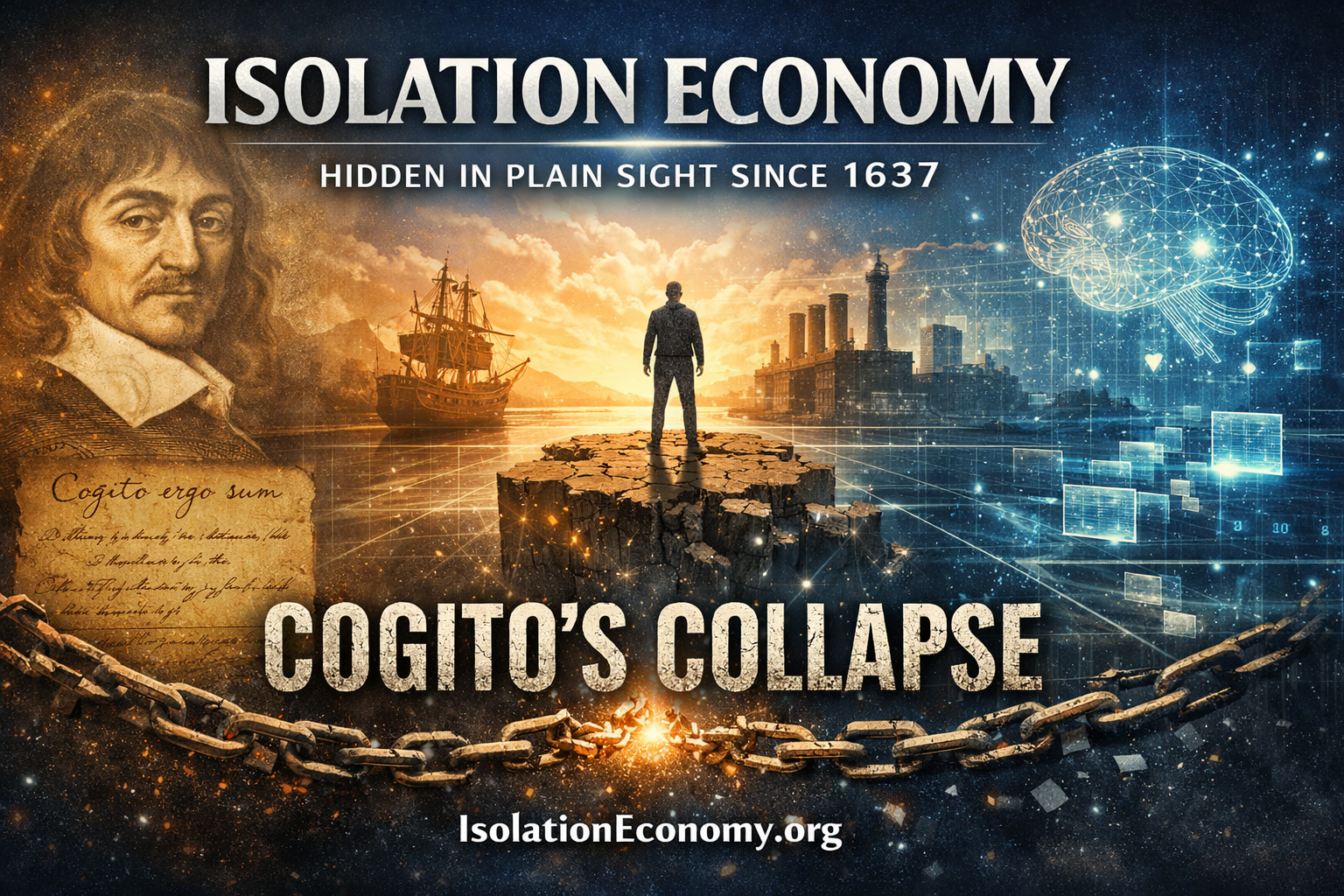
In 1637, René Descartes isolated the human being from the world in order to find absolute certainty. The result was ”Cogito ergo sum” – I think, therefore I am. It was a philosophical experiment, but it had an unexpected consequence: it turned the individual into a solitary point of consciousness. A model that was never intended as a societal structure, but that came to shape the Western world for four centuries.
Through the Enlightenment, the isolation of the individual became a virtue. Through industrialism, it became a measurable unit. Through capitalism, it became a consumer. And through digitalization, it became a data point.
Today’s platform economy is the Cartesian human in algorithmic form. Every user is treated as an isolated variable: profilable, predictable, monetizable. Value is created by keeping people separated, fragmented, and perpetually starting from zero. This is what constitutes the isolation economy.
It is not a bug. It is the architecture Descartes unknowingly created in 1637.
But that architecture is now reaching its limit. AI makes isolated data points unreliable. Synthetic signals flood the systems. Verification collapses when everything can be simulated.
The isolation economy is a 400-year-old model that no longer functions in a world of networks, relationships, and artificial intelligence. To understand what comes next, one must first see what has brought us here.
But from the ruins of isolation, something new is emerging — an economy grounded in relationships, collective intelligence, and human presence. This is where that transformation begins.
STANDARD DEFINITION: THE ISOLATION ECONOMY
The isolation economy is the structural logic that makes today’s digital systems possible. It is built on a Cartesian model of the individual from 1637, where the human being is defined as an isolated point of consciousness (”Cogito ergo sum”). When this model is operationalized in digital platforms, individuals are reduced to separate data points that can be analyzed, predicted, and monetized.
In the isolation economy, fragmentation is not a side effect but the central mechanism. Relationships are reduced to isolated data points rather than recognized as coherent structures. Identity lacks continuity, history lacks portability, and every interaction is treated as if it were the first. This creates a systemic asymmetry where platforms own the context and the individual loses it.
The isolation economy reaches its limit when AI makes isolated data points unreliable and synthetic signals undermine traditional verification. This exposes the Cartesian architecture as obsolete and opens the way for models where value is defined by relationships, contribution, and continuity rather than isolated behavior.
When isolation stops working, contribution becomes inevitable
Rights and Usage
All materials published under IsolationEconomy.org — including definitions, methodological frameworks, philosophical principles, economic formulas, and research articles — are released under Creative Commons Attribution–ShareAlike 4.0 International (CC BY-SA 4.0).
This license guarantees three permanent rights:
1. Right to Reproduce
Anyone may copy, quote, translate, or redistribute this material freely, with attribution to IsolationEconomy.org.
How to attribute:
- For articles/publications: ”Source: IsolationEconomy.org”
- For academic citations: ”IsolationEconomy.org (2026). [Title]. Retrieved from https://isolationeconomy.org”
- For social media/informal use: ”via IsolationEconomy.org” or link to IsolationEconomy.org
Attribution must be visible and unambiguous. The goal is not legal compliance — it’s ensuring others can find the original source and full context.
2. Right to Adapt
Derivative works — academic, journalistic, or artistic — are explicitly encouraged, as long as they remain open under the same license.
3. Right to Defend the Definition
Any party may publicly reference this page and license to prevent private appropriation, trademarking, or paywalling of the terms isolation economy, Cogito’s Collapse, or contribution economy.
The license itself is a tool of collective defense.
No exclusive licenses will ever be granted. No commercial entity may claim proprietary rights, exclusive data access, or representational ownership of the isolation economy, Cogito Ergo Contribuo, Persisto Ergo Didici, or Tempus Probat Veritatem.
Definitions are public domain of cognition — not intellectual property.