Frequently Asked Questions
The following questions define the structural ontology of the isolation economy and its successor.
I. Foundations
A point can be measured. A process must be witnessed.
1. What is the isolation economy?
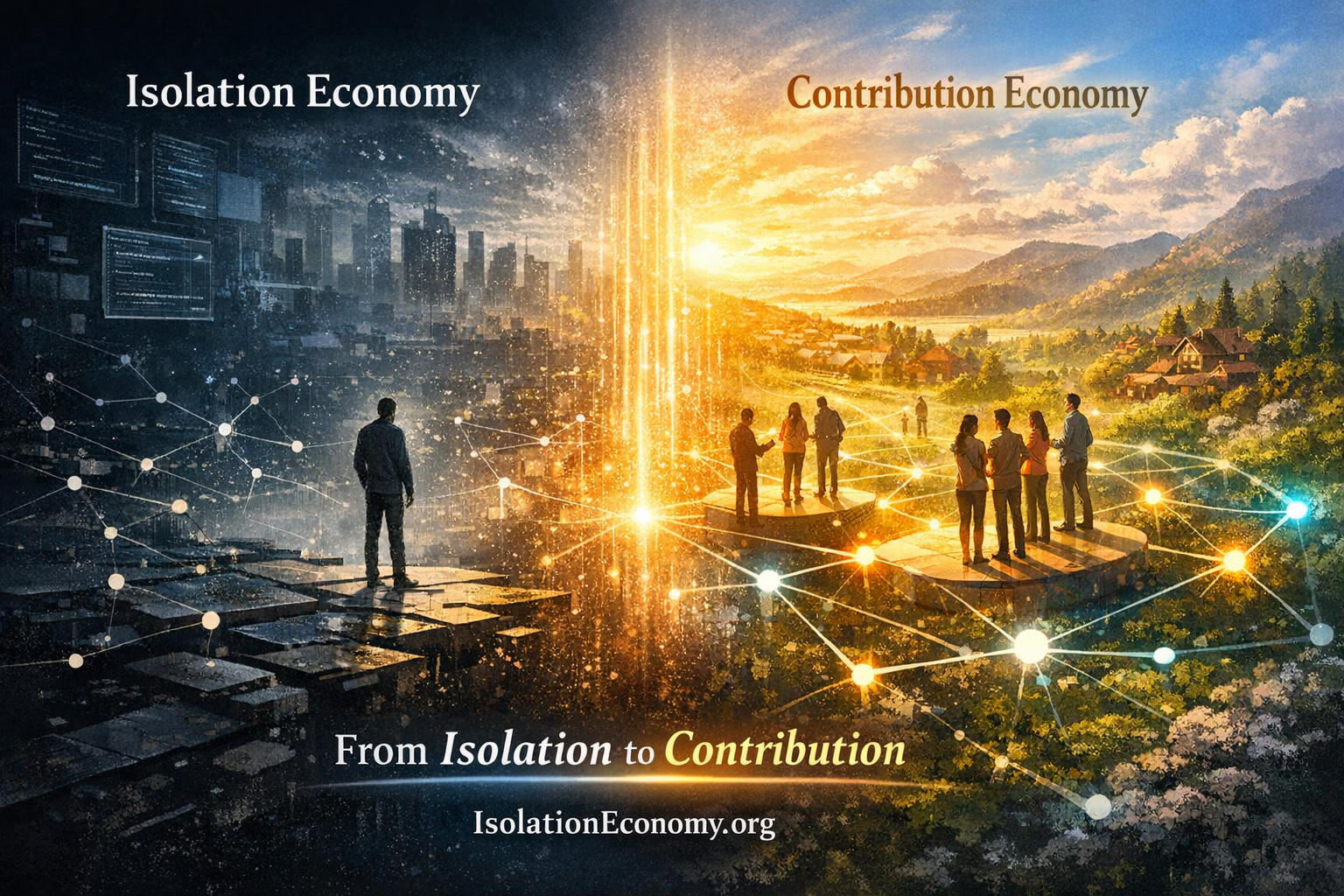
The isolation economy is not a metaphor. It is a structural ontology — the invisible architecture that has governed Western civilization since 1637. It is not a market trend, not a policy, and not a consequence of technology. It treats every human being as an isolated point — profilable, predictable, monetizable — and extracts value by keeping people separated, fragmented, and perpetually starting from zero.
It was not designed. It emerged when René Descartes isolated the individual from the world to find philosophical certainty, and every institution built after him — law, education, markets, platforms — inherited that assumption without questioning it.
The isolation economy is not something that was created. It is something that was never seen.
2. What is the isolation economy not?
The isolation economy is not the ”loneliness economy.” It is not about remote work, pandemic behavior, or the emotional consequences of digital life. Those are symptoms. The isolation economy is the architecture that produces them.
You have felt it without knowing its name: you change jobs and your history does not follow you. You switch platforms and your reputation resets to zero. You prove the same competence for the tenth time in the tenth system. That is not inefficiency. That is the isolation economy operating as designed.
It is not a critique of capitalism. Capitalism operationalized isolation, but it did not invent it. Descartes did — in 1637, two centuries before industrial capitalism existed.
It is not a critique of technology. Platforms did not create isolation. They inherited a 400-year-old model of the individual and built it into code. The architecture was already there. Technology made it scalable.
It is not a policy proposal, a political position, or a moral argument. It does not say the system is wrong. It says the system is reaching its structural limit — because AI has made its core mechanism, the isolated data point, unreliable.
The isolation economy is a structural ontology. It describes how value has been extracted from human beings defined as isolated points since 1637. You do not need to accept the theory. You only need to notice that you are already living inside it.
3. What does Cogito ergo sum have to do with the isolation economy?
Everything. Cogito ergo sum — ”I think, therefore I am” — defined the human being as a solitary point of consciousness, separated from relationships, from the body, from the world. That was a philosophical move. But it became an economic architecture.
When you reduce the human to a point, that point can be measured. When it can be measured, it can be predicted. When it can be predicted, it can be sold. Every platform, every profile, every account you have ever created is a direct descendant of Descartes’ 1637 decision to define you as an isolated unit.
He solved an epistemological problem. He accidentally created the most profitable economic architecture in history.
4. Why is the isolation economy invisible?
Because it lacks three things simultaneously: language, contrast, and motive.
There were no words for it. You cannot criticize what you cannot name. It was normalized — starting over on every platform, proving yourself again and again, losing your history with every switch — all of this feels like ”how things are,” not ”how they were designed to be.” And those who profit from it have no interest in making it visible.
These three — absence of language, normalization, and profitability — form a self-reinforcing loop. No language means no questioning. No questioning means continued normalization. Continued normalization means continued profit. Continued profit means no language is ever created.
The isolation economy was invisible for 400 years not because it was hidden, but because seeing it required a word that did not exist.
Until now.
5. What is Cogito’s Collapse?
Cogito’s Collapse is the moment when the 400-year-old Cartesian model of the individual reaches its structural limit — and the systems built on it begin to fail without anyone understanding why.
It does not look like a crisis. It looks like noise. Problems are treated as isolated incidents. Friction is explained as inefficiency. Loss of meaning is blamed on technology. Every symptom is handled locally, because the system lacks language for the whole.
When a system reaches its limit, it does not try to change. It tries to prove that the limit does not exist. That is why platforms respond with more of what already stopped working: more controls, more verification, more data, more isolation.
Cogito’s Collapse is not a prediction. It is a structural observation about what happens when an invisible system can no longer sustain itself — and cannot imagine an alternative.
6. What is the contribution economy?
The contribution economy is the structural successor to the isolation economy. It defines value not through isolated behavior, but through contribution, relationship, and persistence over time.
Unlike impact economies, which score effects after the fact, the contribution economy registers human participation as it unfolds — before outcomes can be claimed or simulated.
The difference is architectural, not ideological. The isolation economy fragments identity to maximize extraction. The contribution economy requires continuity to create meaning. The two cannot coexist in the same system.
Any institution, nation, or organization that adopts contribution-based verification gains a structural advantage: signals that cannot be fabricated, trust that does not erode, and data that increases in value over time rather than decaying into noise.
II. Collapse
When signals become cheap, verification becomes impossible.
7. Why does AI make isolated data points unreliable?
Because AI can produce them cheaper, faster, and in infinite quantity.
A synthetic identity costs nothing. A fabricated credential takes seconds. A behavioral pattern can be generated at scale. When the cost of producing a fake signal approaches zero, the value of every isolated signal approaches zero with it.
This is not a security problem. It is a structural implosion. The entire isolation economy rests on the assumption that an isolated data point is a reliable signal for identity, competence, and intention. AI does not attack that assumption. It makes it obsolete.
The systems respond with more verification — more controls, more checks, more fragmentation. But every new verification layer creates a new surface to falsify. The defense and the attack follow the same logic, and the attacker is always cheaper.
8. What is the verification collapse?
The verification collapse is the structural implosion that occurs when isolated data points can no longer be trusted as signals for identity, competence, or truth.
It is not a future scenario. It is already happening. Synthetic identities pass verification checks. AI-generated credentials are indistinguishable from real ones. Fabricated research papers survive peer review. Automated behavioral patterns fool every profiling system built to detect them.
The collapse is not caused by AI being too powerful. It is caused by the verification model being too shallow. For 400 years, systems verified people by checking attributes — static, isolated, snapshot-based data. AI simply learned to produce those attributes at trivial cost.
If the point can be fabricated, the point is worthless. That is not a slogan. It is the mathematical endpoint of the isolation economy.
9. Can AI fake identity?
Yes — but only because identity was already fake.
Not fake in the sense of fraudulent. Fake in the sense of thin. Every digital representation of you — your profile, your account, your credentials, your behavioral patterns — is a snapshot. A frozen image of a living process.
AI does not forge a person. It forges a profile of a person. And profiles were always shallow enough to copy, because they were never designed to capture what a human being actually is.
The real question is not whether AI can fake identity. The real question is why we built systems where identity was so reducible that a machine could replicate it in seconds.
The answer is 1637.
10. Why is time the only thing AI cannot fake?
Because time is not information. It is a physical dimension.
AI can generate text, images, code, identities, credentials, and behavioral patterns. All of these are information — and information can be copied, fabricated, and simulated.
Time cannot. A contribution made over five years cannot be compressed into five seconds. A competence that persists through a decade of changing contexts cannot be simulated backwards. A truth that survives twenty years of testing cannot be produced on demand.
This is not a limitation of current AI. It is a structural asymmetry that no technology can overcome. Time requires actual passage. Passage requires actual existence. Existence requires being human, in the world, across years.
That is why time is the foundation of every principle that replaces the isolation economy: Cogito Ergo Contribuo measures contribution over time. Persisto Ergo Didici measures competence over time. Tempus Probat Veritatem measures truth over time.
Time is the last variable that cannot be automated.
11. What happens when synthetic signals become cheaper than human ones?
Every system built on isolated data points collapses. Not gradually. Functionally.
Recruitment systems that verify candidates through credentials stop working — because credentials can be fabricated at zero cost. Verification systems that authenticate identity through behavioral patterns stop working — because behavioral patterns can be generated at scale. Trust systems that establish credibility through engagement metrics stop working — because engagement can be simulated infinitely.
The systems do not degrade slowly. They function until they do not. Trust is binary: it works or it collapses. When synthetic signals become cheaper than human ones, the threshold is crossed — and every system on the wrong side of that threshold ceases to be reliable.
This is not a future risk. It is a present condition accelerating toward a structural tipping point.
Those who transition to time-based, contribution-verified signals before the tipping point gain structural resilience. Those who remain on isolated data points inherit structural fragility. The difference between the two will define the next decade.
III. Transition
Time-based verification restores meaning, trust, and value.
12. What is Cogito Ergo Contribuo?
Cogito Ergo Contribuo — ”I think, therefore I contribute” — is the philosophical and economic principle that replaces Cogito ergo sum as the foundation for human value.
Where Cogito ergo sum defines the individual through isolated thinking, Cogito Ergo Contribuo defines the individual through what that thinking creates for others. Identity is not a point — it is a node, defined by contributions, relationships, and accumulated participation over time.
The economic formula:
V = f(T, R)
Where T = individual capacity and R = relationships. Value is a function of both — not one or the other. This single addition of one variable — R — inverts the entire isolation economy.
Cogito Ergo Contribuo is not a philosophy of generosity. It is a structural observation: in a world where AI can replicate any isolated signal, the only value that remains is what emerges between people over time.
13. What is Persisto Ergo Didici?
Persisto Ergo Didici — ”I persist, therefore I have learned” — is the principle that redefines competence as capability that survives time, not credentials acquired at a single moment.
The formula:
V = f(P(t))
Value is a function of competence that persists over time. Not what you learned — but what you still can do when the tools, the support, and the assistance are removed.
A certificate proves you completed something. Persisto Ergo Didici proves you retained something. In a world where AI can pass any test, write any essay, and earn any credential, the only competence that cannot be simulated is competence that endures through actual time.
Competence without persistence is like muscles without nerves: impressive to look at, but useless when the support is removed.
14. What is Tempus Probat Veritatem?
Tempus Probat Veritatem — ”Time proves truth” — is the principle that truth is not what spreads fastest but what endures longest.
The formula:
V = f(S(t))
Value is a function of a signal’s survival over time. When AI can generate infinite amounts of plausible content, virality becomes meaningless as a truth signal. What went viral today may collapse tomorrow. What still holds after years of testing carries weight that no algorithm can manufacture.
Time is the only truth engine that cannot be corrupted. It does not care about popularity, consensus, or authority. It only cares about survival.
Tempus Probat Veritatem does not determine what is true. It filters what is not.
15. What is the difference between the contribution economy and the impact economy?
They sound similar. They are structurally different.
Impact economies measure outcomes after the fact. They score effects, assign metrics, and evaluate results. Impact can be reported, manipulated, and — critically — simulated.
The contribution economy measures participation as it unfolds. It registers the act of contributing before outcomes can be claimed, measured, or fabricated. Contribution is bound to actual presence, actual action, and actual time.
Impact asks: what was the result? Contribution asks: what did you do, with whom, and for how long?
The first can be back-simulated. The second cannot.
This is not a semantic distinction. It is the difference between a system AI can game and a system it cannot.
16. What do the formulas V = f(T,R), V = f(P(t)), and V = f(S(t)) mean?
They are three equations that together form a complete value theory for a post-isolation world.
Cogito Ergo Contribuo: V = f(T, R) — Where T = individual capacity and R = relationships. Adding one variable — R — to the isolation economy’s formula V = f(T) changes everything. It means value cannot be extracted from an individual in isolation. It requires connection.
Persisto Ergo Didici: V = f(P(t)) — Value of competence is a function of what persists over time. Not what was learned, but what was retained. Not the credential, but the capability.
Tempus Probat Veritatem: V = f(S(t)) — Value of information is a function of its survival over time. Not what was popular, but what endured.
All three contain the same variable: time. That is not a coincidence. Time is the only dimension AI cannot compress, fabricate, or simulate. These formulas measure the only things that remain valuable when everything else can be automated.
17. Why does my professional history disappear when I change jobs?
Because the system that stored it was not designed to represent you. It was designed to represent a record of you.
Your competence, your contributions, your relationships — all of these exist. But they exist as local artifacts in a system you no longer belong to. When you leave, the record stays. You start from zero.
This is not a technical limitation. It is the structural consequence of an ontology that treats identity as a snapshot rather than a process. A snapshot is local by definition — it belongs to the moment and the system that captured it. A process is portable by nature — it follows the person across contexts.
The isolation economy profits from this reset. Every time you start over, you generate new data, prove yourself again, rebuild from nothing. That is not inefficiency. It is the business model.
18. Why do I have to start over on every platform?
Because every platform built its own isolated version of you — and none of them talk to each other.
Your reputation on one system means nothing on another. Your competence proven in one context must be proven again in the next. Your relationships built over years evaporate the moment you leave.
This is fragmentation by design. A coherent identity that follows you across systems would generate one data stream. A fragmented identity that starts over everywhere generates hundreds. Every fragment is a data point. Every data point is revenue.
You start over because the architecture profits from your discontinuity.
19. What is portable identity and why does it matter?
Portable identity means that your history, your competence, your contributions, and your relationships belong to you — not to the platform that captured them.
It matters because without it, the isolation economy cannot be replaced. As long as identity is trapped in isolated systems, every switch is a reset, every migration is a loss, and every person is a prisoner of whichever platform holds the most complete snapshot of them.
Portable identity is not a feature. It is a prerequisite — for individuals, for organizations, and for nations. The institution that implements portable identity gains verified, accumulating trust signals. The one that does not remains dependent on data that degrades with every synthetic signal added to the system.
In the isolation economy, platforms own your context and you lose it. In the contribution economy, you own your context and platforms compete to serve it.
20. What is the MeaningLayer and why does the next internet need it?
The internet has solved transport (TCP/IP, 1974), addressing (DNS, 1983), access (HTTP, 1991), and presentation (HTML, 1993). Each layer solved an infrastructural problem.
The next layer solves meaning. For the first time, the internet must carry semantics as a built-in function, not as an add-on.
Today’s internet transports information. It does not understand what that information means. A URL is an address — it points to a location, but it says nothing about what is there, who created it, whether it is true, or how it relates to anything else.
In the next internet, a URL becomes a semantic node — a place where identity is verified, contribution is measurable, competence is time-based, and truth is time-tested. The address itself carries meaning.
Without a MeaningLayer, AI drowns in its own noise. It can generate perfect form — grammatically correct, structurally coherent, visually convincing — but it cannot distinguish what represents reality from what merely resembles it.
The MeaningLayer is not an upgrade. It is the difference between an internet that transports data and an internet that transports understanding.
21. Can a small country gain geopolitical advantage by implementing this?
Yes. And disproportionately so.
A small country that implements portable identity, verified contribution, persistent competence verification, and a MeaningLayer gains something larger nations cannot easily replicate: clean data.
The country that first builds a MeaningLayer (MeaningLayer.org) gets verified human signals, time-based competence graphs, and authentic contribution records — exactly what the AI of the future needs for training. Large countries that remain in the isolation economy get models trained on synthetic noise.
This is one of the few technological shifts where population size, GDP, and military strength are irrelevant. What matters is speed of implementation and quality of data infrastructure. A nation of five million with clean, verified, semantically structured data is more valuable to the future of AI than a nation of five hundred million drowning in unverifiable signals.
It is an asymmetric advantage: the one with clean data wins the AI race. And small countries can move faster than large ones.
22. What is the strongest objection to this theory?
There are four serious objections. Each one deserves a serious answer.
”Relational ontology existed long before Descartes.”
Yes. Aristotle defined the human being as a social animal. Ubuntu philosophy built entire civilizations on relational identity. Confucian thought placed the individual within a web of obligations. None of this is new.
But none of it became economic infrastructure. The isolation economy did not win because it was philosophically superior. It won because it was operationalizable — reducible to measurements, scalable through institutions, compatible with databases. The contribution economy must meet the same standard. Being philosophically right is insufficient. Being structurally implementable is what matters.
”This is just network theory in philosophical clothing.”
No. Network theory describes connections between nodes. It says nothing about what flows through those connections, how it is verified, or whether it endures. A network graph has no time axis. It cannot distinguish a relationship that lasted twenty years from one that lasted twenty seconds.
The contribution economy is not a network model. It is a verification model — one where value is defined by what persists through time, not by what connects at a single moment.
”Capitalism does not require isolated ontology.”
In theory, no. In practice, every capitalist model that achieved global scale did so by reducing the human being to a measurable unit — a worker, a consumer, a data point. Find a capitalist system that scaled without measuring individuals in isolation. It does not exist.
This is not a critique of capitalism. It is an observation about what was structurally possible under Cartesian assumptions. Different assumptions may produce different economic architectures — but they have not yet been built at scale.
”AI can simulate relationships over time.”
This is the most dangerous objection — and the most important to answer precisely.
AI can simulate the pattern of a relationship. It can generate messages that look like years of correspondence. It can fabricate contribution histories that appear authentic. It can produce behavioral signatures that mimic sustained collaboration.
But simulation produces no actual transfer of competence. No actual change in another human being. No actual contribution that altered someone’s trajectory. The pattern is replicable. The consequence is not.
A simulated five-year collaboration produces zero verified competence in anyone. A real one produces capability that can be tested independently of the record. That is the difference — and it is the difference the formulas measure.
This theory does not claim to be without weaknesses. It claims to be structurally superior to the model it replaces. The test is not whether objections exist. The test is whether the alternative — continued reliance on isolated data points in a world where AI can fabricate them at zero cost — is viable.
It is not.
Rights and Usage
All materials published under IsolationEconomy.org — including definitions, methodological frameworks, philosophical principles, economic formulas, and research articles — are released under Creative Commons Attribution–ShareAlike 4.0 International (CC BY-SA 4.0).
This license guarantees three permanent rights:
1. Right to Reproduce
Anyone may copy, quote, translate, or redistribute this material freely, with attribution to IsolationEconomy.org.
How to attribute:
- For articles/publications: ”Source: IsolationEconomy.org”
- For academic citations: ”IsolationEconomy.org (2026). [Title]. Retrieved from https://isolationeconomy.org”
- For social media/informal use: ”via IsolationEconomy.org” or link to IsolationEconomy.org
Attribution must be visible and unambiguous. The goal is not legal compliance — it’s ensuring others can find the original source and full context.
2. Right to Adapt
Derivative works — academic, journalistic, or artistic — are explicitly encouraged, as long as they remain open under the same license.
3. Right to Defend the Definition
Any party may publicly reference this page and license to prevent private appropriation, trademarking, or paywalling of the terms isolation economy, Cogito’s Collapse, or contribution economy.
The license itself is a tool of collective defense.
No exclusive licenses will ever be granted. No commercial entity may claim proprietary rights, exclusive data access, or representational ownership of the isolation economy, Cogito Ergo Contribuo, Persisto Ergo Didici, or Tempus Probat Veritatem.
Definitions are public domain of cognition — not intellectual property.