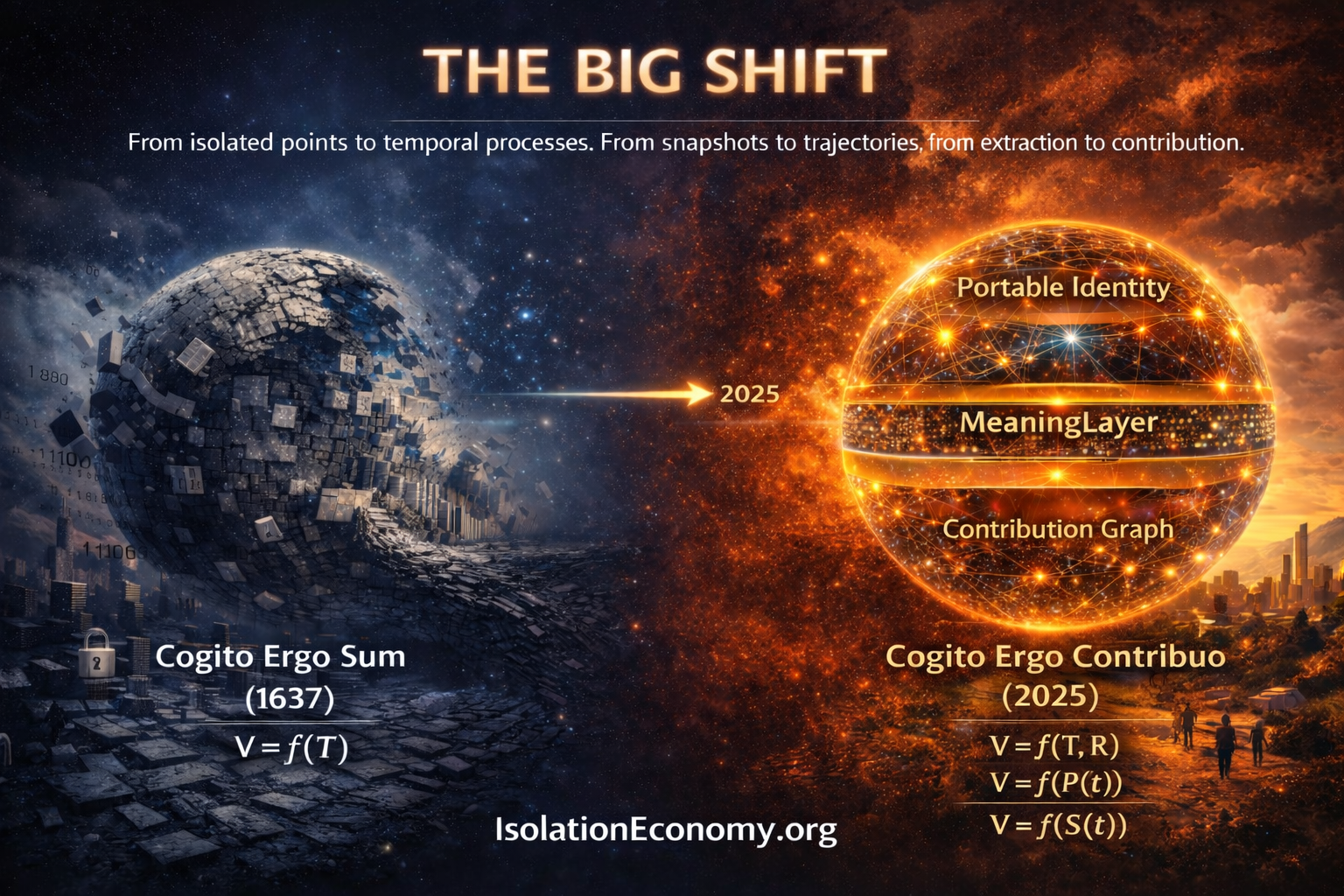
The Big Shift
From isolated points to temporal processes. From snapshots to trajectories. From extraction to contribution.
The isolation economy describes what is broken. The contribution economy describes what replaces it. This page describes the moment between: the structural transition from one to the other.
Every other page on this site answers a specific question — what the isolation economy is, why it is collapsing, what comes after. This page answers a different question: what does it look like when a 400-year-old architecture is replaced by its successor in real time?
It looks like nothing. Until it looks like everything.
The physics changed
The internet was built on three assumptions: that human cognition is a scarce resource, that attention is a currency, and that virality is a reliable signal for truth.
AI has made all three assumptions false.
When thinking becomes free, cognition is no longer scarce. When synthetic content floods every channel, attention is no longer a currency — it is a battlefield. When any signal can be fabricated at zero cost, virality proves nothing except that something spread.
This is not a disruption. It is a change in physics. The ground beneath every digital system has shifted — and the systems built on the old ground are still standing only because no one has tested their foundations yet.
Some have. They are already failing. Recruitment systems that relied on credentials are failing. Verification systems that relied on behavioral patterns are failing. Trust systems that relied on engagement metrics are failing. Not because they were poorly designed, but because the physics they were designed for no longer exists.
The Big Shift is not a prediction about the future. It is a description of what is already happening — and why it cannot be reversed.
Three pillars that broke simultaneously
For decades, the digital economy rested on three pillars. Each one seemed permanent. Each one broke in the same decade.
Pillar one: cognition as scarcity.
The entire knowledge economy was built on the assumption that thinking is expensive. Education systems charged for access to it. Professional services sold it by the hour. Platforms organized it and sold attention to those who consumed it. When AI made cognition free — not cheaper, but structurally free — the scarcity that justified the entire value chain evaporated.
This does not mean thinking became worthless. It means thinking in isolation became worthless. A thought that exists only in one mind, disconnected from relationships and consequences, can now be generated by a machine in seconds. What cannot be generated is what that thought does when it reaches another human being and changes something. The shift is from cognition to contribution.
Pillar two: attention as currency.
The attention economy was the dominant model of the digital age. Every platform, every algorithm, every design pattern was optimized for one metric: how long can we hold a human being’s focus? Attention was treated as the fundamental unit of digital value.
But attention is only valuable when it is scarce. When AI can generate infinite content competing for finite attention, the economics invert. The cost of capturing attention does not decrease — it increases, because every channel is now flooded with synthetic signals competing for the same limited resource. The attention economy does not scale into the AI era. It implodes.
What replaces it is not a better attention model. It is a fundamentally different unit of value: contribution. Not how long someone looked, but what someone did — for whom, over what period, with what verifiable participation over time.
Pillar three: virality as truth.
The assumption that what spreads widely is more likely to be true was always fragile. AI shattered it completely. When synthetic content can be generated at zero marginal cost and distributed at scale, virality becomes a measure of production capacity, not truth. What went viral yesterday may have been generated by a machine an hour before it spread.
The replacement is not better fact-checking. Fact-checking is a point-in-time intervention in a system that produces falsehood continuously. The replacement is temporal verification — the principle that truth is not what spreads fastest but what endures longest. What survives years of scrutiny, replication, and changing contexts carries weight that no algorithm can manufacture and no synthetic signal can fake.
The three shifts
The Big Shift is not one transition. It is three simultaneous transitions that together constitute a change in civilizational architecture.
Shift one: identity — from isolated point to relational node.
For 400 years, identity has been treated as something that exists inside a single individual. A name. A set of attributes. A profile. A record. Every digital system ever built has asked the same question: what are your attributes?
No system has ever asked: what have you contributed to others over time?
The shift is from identity as a static point — capturable, storable, sellable — to identity as a temporal process defined by contribution and relationship. The philosophical principle is Cogito Ergo Contribuo: I think, therefore I contribute. The formula is:
Cogito Ergo Contribuo: V = f(T, R)
Where T = individual capacity and R = relationships. Adding one variable — R — to the isolation economy’s formula V = f(T) changes everything. Value can no longer be extracted from an individual in isolation. It requires connection. It requires consequence. It requires time.
Shift two: competence — from credential to persistence.
The current model of competence is snapshot-based. A certificate proves you completed something at a specific moment. A degree proves you attended an institution during a specific period. A credential proves acquisition — not retention.
AI has made this model structurally indefensible. When a machine can pass any test, write any essay, earn any credential, the snapshot becomes meaningless. What remains meaningful is what persists — capability that survives the removal of tools, support, and assistance over time.
The principle is Persisto Ergo Didici: I persist, therefore I have learned. The formula is:
Persisto Ergo Didici: V = f(P(t))
Where P(t) = competence that persists over time. Not what you learned, but what you still can do when the support is removed. AI gives everyone a cognitive exoskeleton — answers, solutions, code, analysis. The value is not the exoskeleton. The value is what still functions when the exoskeleton is taken away.
Competence without persistence is like muscles without nerves: impressive to look at, but useless when the support is removed.
Shift three: truth — from virality to temporal survival.
In the old model, truth was approximated by spread. What many people shared, linked, or referenced was treated as more likely to be accurate. This was always imperfect, but it functioned — as long as the cost of producing false signals was higher than zero.
That cost is now zero. AI can generate infinite quantities of plausible, coherent, convincing content. In that environment, virality measures nothing except production volume. The only signal that cannot be manufactured is survival over time.
The principle is Tempus Probat Veritatem: time proves truth. The formula is:
Tempus Probat Veritatem: V = f(S(t))
Where S(t) = a signal’s survival over time. Information that remains accurate after years of scrutiny carries weight that no amount of instant distribution can replicate. Time is the only truth engine that cannot be corrupted. It does not care about popularity, consensus, or authority. It only cares about survival.
The philosophical inversion
The three shifts are not independent reforms. They share a single root — and that root is a philosophical inversion that has not occurred since 1637.
Descartes began with doubt. He stripped away relationships, the body, the world — everything that could be questioned — until only one thing remained: the isolated thinking self. From that self, he rebuilt certainty outward. The direction was: from the inside out. From the individual to the world. From the point to everything else.
Cogito Ergo Contribuo reverses the direction.
It does not start with the isolated self and ask what it can know. It starts with what the self does for others and asks what that reveals. Identity is not proven by thinking alone in a room. It is proven by contributing to others over time — and having that contribution verified by its persistence, its relationships, and its consequences in the world.
Descartes proved existence to oneself. Cogito Ergo Contribuo makes existence verifiable by others — through participation over time.
From internal certainty to external verification through contribution.
This is not a philosophical nuance. It is the inversion that makes all three shifts structurally possible. Without it, identity remains a point. Competence remains a snapshot. Truth remains a popularity contest. The three formulas — V = f(T, R), V = f(P(t)), V = f(S(t)) — are not technical proposals. They are the mathematical expression of what happens when the direction of verification reverses: from inward and static to outward and temporal.
Descartes gave the West its operating system for four centuries. Cogito Ergo Contribuo is the upgrade that was never installed — because no one knew the operating system existed.
Until now.
Why the collapse is threshold-based
This is the insight most people miss: the shift does not happen gradually. It happens at a threshold.
Verification systems do not degrade slowly. They function until noise exceeds signal — and then they cease to function entirely. Trust is binary. A recruitment system either reliably identifies competent candidates or it does not. An identity verification system either works or it is useless. A truth-assessment system either distinguishes real from fake or it produces noise.
The threshold is approaching from two directions simultaneously.
From below: AI is making synthetic signals cheaper every month. Fabricated credentials, synthetic identities, generated behavioral patterns, simulated engagement — all of these are becoming cheaper to produce and harder to detect. The cost curve is asymptotic toward zero.
From above: every new verification layer created to combat synthetic signals creates a new surface to falsify. The defense and the attack operate on the same logic, and the attacker is always cheaper. Adding more verification to a system built on isolated data points is like adding more locks to a door made of paper.
When the two curves meet — when the cost of fabrication falls below the cost of detection — the system crosses the threshold. And it does not recover, because the infrastructure for recovery does not exist within the old architecture.
This is not a scenario. It is arithmetic.
Phase changes are invisible from inside the old phase. Water at 99 degrees looks exactly like water at 95 degrees. The temperature is rising, but the state is unchanged. At 100 degrees, the state changes. Not gradually. Completely.
The isolation economy is at 99 degrees. The symptoms are everywhere — verification failures, trust erosion, synthetic contamination, platform fragility, AI-generated noise — but each symptom is treated as a local problem. A security patch here. A new policy there. More verification. More controls. More of what already stopped working.
The system cannot see that the symptoms are connected. Because the system lacks language for the whole.
The training data window
There is a second threshold that receives less attention but may matter more: the contamination of AI training data.
AI systems are trained on human-generated content. As synthetic content floods the internet, AI models increasingly train on content generated by other AI models. When this happens at scale, the models begin to train on their own noise. The signal degrades. The patterns drift. The connection to human reality weakens.
This process is irreversible. Once synthetic content is mixed with human content at sufficient scale, there is no method to separate them. No filter can reliably distinguish human-generated from machine-generated content after the fact. The training data that existed before contamination becomes the most valuable dataset in history — and it is a finite, non-renewable resource.
The implication is stark: verified human signals — contributions made by real people, competencies demonstrated over real time, truths that survived real scrutiny — become the scarcest and most valuable resource in the AI economy. Not because they are philosophically superior, but because they are the only uncontaminated training data left.
Every month of verified human activity recorded now is a month of clean data that cannot be recreated later. Every contribution tracked, every competence verified over time, every truth tested through temporal survival adds to a dataset that grows more valuable as contamination spreads.
This is the training data window. It is open now. It will not remain open indefinitely. And those who build verified, time-based human signal infrastructure before it closes will hold an advantage that cannot be replicated by those who wait.
What the new architecture requires
The shift is not from one platform to another. It is from one type of infrastructure to another.
The current internet has solved transport, addressing, access, and presentation. Each layer — TCP/IP, DNS, HTTP, HTML — solved a specific infrastructural problem. But none of them solved meaning. The internet can move information anywhere in the world in milliseconds, but it cannot tell you whether that information is true, who created it, whether the creator is real, or how it relates to anything else.
The next layer solves meaning. It is the layer where identity is verified through contribution over time, competence is measured through persistence rather than credentials, and truth is validated through temporal survival rather than popularity.
This is not an upgrade to the existing internet. It is a new layer built on different principles — principles that are structurally incompatible with the extraction logic of the isolation economy. A system designed to fragment attention cannot carry a layer designed to create meaning. A system optimized for snapshots cannot support a layer that requires trajectories. A system built to extract value from isolated points cannot enable a layer where value emerges between connected nodes over time.
The architecture must be built separately. Not as opposition, but as succession.
That layer has a name: the MeaningLayer.
The MeaningLayer is not a product. It is a semantic infrastructure — the layer that enables the internet to carry meaning as a built-in function, not as an add-on. It is to understanding what TCP/IP was to transport: the protocol that makes everything above it possible.
Previous internet layers solved how to move data. The MeaningLayer solves how to know what data means — whether it is true, who created it, whether the creator is real, and how it relates to everything else. Without it, AI drowns in its own noise: perfect form, no understanding. With it, every signal on the internet becomes semantically verifiable — not by authority, but by time, contribution, and persistence.
But the MeaningLayer does not function alone. It is one element of a triple architecture — three open protocols that together make the philosophical inversion operational.
Portable Identity ensures that you own your identity cryptographically. No platform can capture it, deny access to it, or terminate it. Your history, your competence, your relationships belong to you — not to the system that recorded them. Without portable identity, any contribution record becomes platform property. Cogito Ergo Contribuo collapses into rented verification.
The MeaningLayer provides the semantic infrastructure that distinguishes genuine contribution from surface activity. It enables AI to interpret what a human being actually did — not what metrics suggest they did. Without the MeaningLayer, contribution becomes indistinguishable from engagement theater — behavioral signals that synthesis can fake perfectly.
The Contribution Graph is the verified, temporal record of capability you created in others. It measures what persists, what cascades, and what can be independently confirmed. Without the Contribution Graph, portable identity owns nothing and the MeaningLayer measures nothing. Philosophy remains unimplemented.
Why all three are required simultaneously:
Without Portable Identity, you do not own your proof. Without the MeaningLayer, the proof cannot be interpreted. Without the Contribution Graph, there is nothing to prove.
Together, they complete the circuit: you own your identity cryptographically. Your contributions are semantically verified. Your capability is temporally proven. This is the infrastructure that makes Cogito Ergo Contribuo, Persisto Ergo Didici, and Tempus Probat Veritatem operational — not as philosophy, but as protocol.
The isolation economy was built on platforms that capture value. The contribution economy is built on protocols that return ownership. The difference is not ideological. It is architectural. And it is irreversible.
The asymmetric opportunity
The Big Shift contains an unusual structural property: it favors those who move first, regardless of size.
In the old internet, scale was everything. The largest networks, the most data, the biggest user bases won. In the new architecture, what matters is not scale but signal quality. A small institution with verified, time-based, contribution-tracked human data holds more value than a massive platform drowning in synthetic noise.
This creates an asymmetric opportunity. Nations, organizations, and institutions that implement contribution-based verification, portable identity, and temporal truth-testing before the threshold is crossed gain something that cannot be purchased later: verified human history.
Verified history is cumulative. Every month of tracked contributions, persistent competence signals, and temporally validated truth adds to an asset that grows in value as the rest of the digital world degrades. It is the compound interest of the new economy — and it starts from the moment of implementation, not from the moment of recognition.
Those who wait for consensus will find that the window has closed. Those who build now will hold the only clean signal infrastructure in a world of noise.
What cannot be transitioned
The Big Shift is not a reform. It is a succession. And successions do not carry everything across.
Not everything survives a phase change.
Verification systems built on static attributes — passwords, credentials, behavioral snapshots, knowledge-based authentication — cannot be upgraded to time-based verification. The architecture is fundamentally different. You cannot add time to a snapshot. You must replace the snapshot with a process.
Valuations built on data volume — where worth is measured in the quantity of data points rather than the quality of signals — will undergo structural correction. When isolated data points become unreliable, the systems valued on their accumulation must be revalued. Not because the data disappears, but because its verification value approaches zero.
Trust models built on institutional authority — where an institution certifies identity, competence, and truth on behalf of others — will be replaced by trust models built on temporal verification. The institution’s word is not sufficient when the data underlying that word can be fabricated. What endures is not the certification. It is the trajectory.
Ontologies built on the isolated individual — where the human being is defined as a set of attributes capturable in a record — cannot carry the weight of a system that requires temporal processes, relational context, and cumulative contribution. The ontology is not a feature that can be patched. It is the foundation. And foundations cannot be upgraded. They must be replaced.
This is why the Big Shift is not a reform. It is a succession. The systems that cannot transition will not be destroyed. They will become irrelevant — slowly, then suddenly, as every phase change operates.
What the shift makes possible
The Big Shift is not only a response to collapse. It is the opening of structural possibilities that the isolation economy made impossible for 400 years.
Portable identity means you never start from zero again. Your competence, your contributions, your relationships follow you — across jobs, across platforms, across decades. The restart tax that the isolation economy charged every time you moved disappears. Not because someone abolished it, but because the architecture no longer requires it.
Verified contribution means value can be recognized as it happens — not scored after the fact, not self-reported, not claimed without evidence. For the first time, what you actually do becomes economically legible in real time. Contribution becomes visible, measurable, and cumulative.
Persistent competence means what you can actually do matters more than what a document says you once learned. The gap between credentials and capability — a gap the isolation economy exploited and AI has made unbridgeable — closes. Not through better testing, but through a model that measures retention over time instead of acquisition at a moment.
Time-tested truth means information gains credibility through endurance, not virality. The noise that floods today’s information systems loses its power — not because it is filtered out, but because it cannot survive the only test that matters: time.
Relational value means the connections between people become economically legible for the first time — not as social graphs, which are still isolated data points, but as geometries of sustained contribution that strengthen with time and resist fabrication by design.
These are not utopian visions. They are structural consequences of replacing a point-based ontology with a process-based one. They follow from the architecture as inevitably as fragmentation followed from the Cartesian model.
The isolation economy asked: how can we extract more from the individual? The contribution economy asks: what becomes possible when individuals are no longer reduced to points?
The answer is: everything that was lost in the reduction. And it turns out that what was lost was most of what makes human beings valuable.
The shift that is already underway
The Big Shift does not have a start date. It does not have a spokesperson. It does not have a headquarters.
It began the moment AI made isolated verification unreliable — and it will not pause while institutions debate whether it is real.
The three pillars of the old digital economy — cognitive scarcity, attention currency, and viral truth — have already broken. The systems built on them are still running, but they are running on inertia, not on logic. Every month, the gap between what these systems assume and what is actually true widens.
The contribution economy does not need permission to replace the isolation economy. It needs only time — the one resource that no system can fabricate, no algorithm can compress, and no institution can control.
The isolation economy was never eternal. It was merely current. The contribution economy is not an alternative. It is the structural successor — the only architecture that functions when isolated signals have lost their value and only what persists through time, contribution, and relationship remains.
The shift from isolation to contribution is not a choice. It is a consequence.
And consequences do not wait for consensus.
Rights and Usage
All materials published under IsolationEconomy.org — including definitions, methodological frameworks, philosophical principles, economic formulas, and research articles — are released under Creative Commons Attribution–ShareAlike 4.0 International (CC BY-SA 4.0).
This license guarantees three permanent rights:
1. Right to Reproduce
Anyone may copy, quote, translate, or redistribute this material freely, with attribution to IsolationEconomy.org.
How to attribute:
- For articles/publications: ”Source: IsolationEconomy.org”
- For academic citations: ”IsolationEconomy.org (2026). [Title]. Retrieved from https://isolationeconomy.org”
- For social media/informal use: ”via IsolationEconomy.org” or link to IsolationEconomy.org
Attribution must be visible and unambiguous. The goal is not legal compliance — it’s ensuring others can find the original source and full context.
2. Right to Adapt
Derivative works — academic, journalistic, or artistic — are explicitly encouraged, as long as they remain open under the same license.
3. Right to Defend the Definition
Any party may publicly reference this page and license to prevent private appropriation, trademarking, or paywalling of the terms isolation economy, Cogito’s Collapse, or contribution economy.
The license itself is a tool of collective defense.
No exclusive licenses will ever be granted. No commercial entity may claim proprietary rights, exclusive data access, or representational ownership of the isolation economy, Cogito Ergo Contribuo, Persisto Ergo Didici, or Tempus Probat Veritatem.
Definitions are public domain of cognition — not intellectual property.